Best AI Voice for a Virtual Receptionist: What to Test
The best AI receptionist voice isn't the fanciest. Learn what makes callers trust an AI voice, how to test it in a demo, and whether it should say it's AI.
Read the guide →Guides
Compare the four types of AI virtual receptionist available to US businesses in 2026, what 24/7 coverage and live transfer really involve, and how to test a provider.
For the wider workflow, explore AI Receptionist for Business: 24/7 Answering & Booking. For a related operating question, read AI Receptionist Calendar Failures: Avoid False Bookings.
AI-assisted editorial guide from Telephoned.pro, a provider in this category. Updated October 17, 2026. This guide compares service types rather than naming or ranking providers. Capabilities and pricing depend on the agreed setup; confirm the terms for your business.
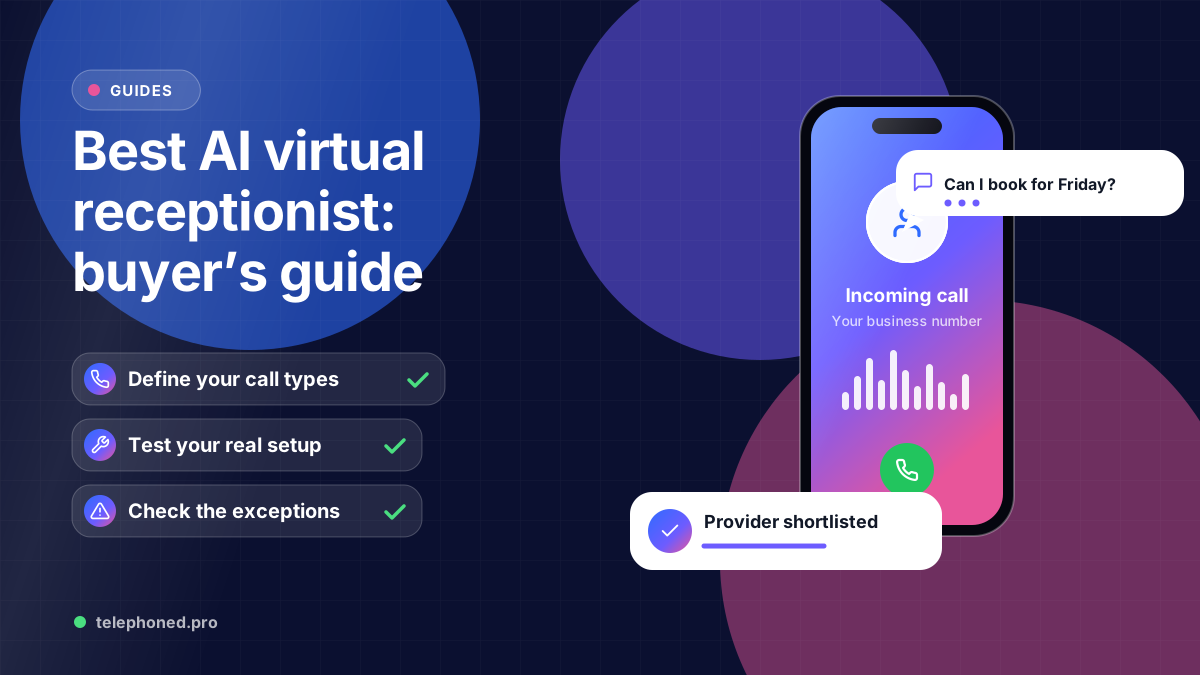
The best AI virtual receptionist for your business is the one that handles your real calls, preserves useful context and completes the next step reliably. A natural voice is useful, but it does not prove that a caller reached the right team or that an appointment exists.
For US service businesses, start with the service territory, branch hours, calendar rules and staff handoff. Use those requirements to evaluate providers rather than treating one system as the best choice for every business. This guide covers selection criteria; the linked demo checklist provides a more detailed call-by-call test.
Most providers US businesses evaluate in 2026 fall into four types. The best type for you depends on how many calls you receive, how often callers need a person, and how much of the work after the call you want handled automatically.
These labels can overlap: a virtual receptionist may be a remote person, AI or a hybrid service. Compare the actual call workflow and contract rather than assuming the label guarantees a capability. The table lists what to verify, not universal promises about every service.
| Criteria | AI receptionist | Answering service | Virtual receptionist |
|---|---|---|---|
| 24/7 coverage | Can be configured for all calls, overflow or after hours. | Depends on staffed coverage in the service agreement. | Confirm whether the service is human, AI or hybrid and which hours are covered. |
| Live transfer to a person | Uses configured contacts and fallback rules; test unanswered transfers. | Ask which calls are transferred and what happens outside staffed hours. | Confirm transfer availability and who owns a missed handoff. |
| Call summaries | Structured details and summaries depend on the configured workflow. | Messages or summaries depend on the agreed script and service. | Ask what staff receive and how unresolved requests are identified. |
| Lead qualification | Applies your approved intake questions and routing rules. | Confirm which qualification questions staff can ask. | Confirm whether qualification is included or limited to message-taking. |
| Booking into your calendar | Requires a supported calendar connection, availability rules and failure handling. | Ask whether staff can write into your actual calendar. | Check the calendar connection and evidence of a confirmed booking. |
| Typical pricing model | Setup and subscription or usage-based terms; Telephoned.pro quotes setup plus monthly. | Check for subscriptions, call or minute allowances and additional charges. | The label alone does not define pricing; confirm setup, subscription and usage terms. |
| Best fit | Repeatable intake, scheduling and connected follow-up with human escalation. | Businesses that want staffed answering under a defined script and handoff agreement. | Businesses seeking a remote front desk; choose the human, AI or hybrid setup by the work required. |
The best AI phone receptionist is the one that can handle your actual calls and show the resulting next action. Use this checklist during a demo and ask to inspect the records after the conversation.
Telephoned.pro is an implementation-led AI receptionist service. It answers calls on your existing business number 24/7, qualifies the caller, books the appointment and hands the work to follow-up, CRM, invoicing and review workflows. It suits businesses that want the receptionist connected to the rest of their operations. If you only need simple message-taking, a lower-cost AI-first service may be enough.
Round-the-clock answering matters most when new work arrives outside office hours: emergency and home-service trades, healthcare and legal intake, and businesses that advertise in the evening or at weekends. A caller who reaches voicemail at 9 p.m. often calls the next company instead.
Coverage alone is not the goal. Decide what each after-hours call should produce: a booked appointment, an urgent escalation to the person on call, or a clear callback time. Then test those outcomes, not only whether the phone was answered.
An AI virtual receptionist is a software-based phone assistant configured to handle business conversations. Depending on its setup, it can capture inquiries, answer approved routine questions, support scheduling and route requests to people. Capabilities vary with the phone routing, knowledge, integrations and operating rules.
A human receptionist or answering service can also support these tasks. Compare how each option handles your call types, exceptions and staff coverage. Neither a polished demonstration nor a familiar job title establishes how reliably the entire workflow will run.
Bring one real scenario to your demo. We will review the intended next step, existing systems and human handoffs.
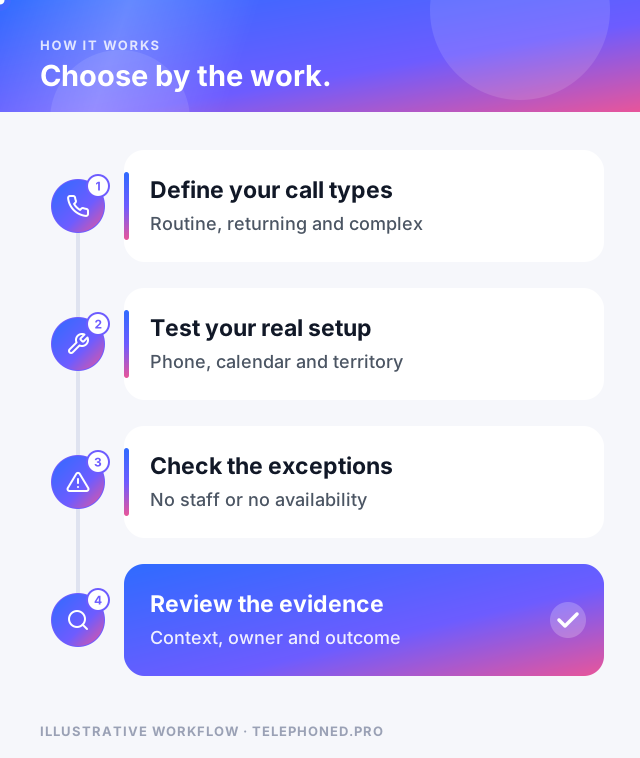
Secure your spotFirst, check context. Can staff see what the caller asked, the relevant contact details and the current next action? A summary should distinguish facts from uncertain interpretation and leave a practical correction path.
Second, check your service rules. A national business may need several branches and time zones; a local contractor may need specific ZIP codes and service categories. The system should use those maintained rules instead of assuming every caller can book.
Third, check execution. If an appointment is offered, ask to see the accepted calendar record. If the calendar rejects the write, the caller should receive an accurate fallback rather than a confirmation for a booking that does not exist.
“Judge an AI virtual receptionist by what happens after the call: the booking, the handoff and the record your team can act on.”
Fourth, check handoff. When the caller asks for a person or the request needs staff judgment, examine the receiving queue, owner and backup. A notification sent to several people does not establish that someone accepted the case.
Ask the provider to confirm which requirements are supported for your setup. Do not assume that every calendar, field-service platform, language or phone configuration is connected simply because it appears in a marketing example.
Use the same scenarios with each option. Include a new inquiry, a returning caller, a request outside the service area and an unavailable staff member. Add a failed scheduling update so you can inspect what the caller is told and how the exception reaches the team.
Review the records after each test, not only the conversation. Compare the captured request, routing decision, next owner and verified outcome. Mark missing context, incorrect information and unsupported promises as issues to resolve before expanding coverage.
A caller may need a specialist, dispute an earlier answer, describe a sensitive situation or provide information the system cannot verify. Design the handoff around what your team can responsibly handle. Automated intake should not invent technical diagnosis, legal advice or an urgent response that your business has not approved.
The right balance can combine routine AI intake with staff responsibility for exceptions. During evaluation, identify the point where the conversation leaves automation and how the receiving person obtains enough context to act.
Start with a defined set of call types and review a sample of actual interactions. Track unresolved requests, unaccepted callbacks, routing failures and verified appointments. Use your own records to assess whether the workflow helps the team; do not treat every captured contact as a qualified lead or every completed call as a booking.
Retest when you change services, hours, staff or connected tools. Keep an owner for maintaining the call rules and a visible way for employees to report problems.
There is no single best choice for every small business. Start with coverage, qualification, calendar booking, summaries and human escalation, then compare the same call scenarios. The useful option depends on your tools, call patterns and the work your team needs completed.
Routine intake may be suitable for automation, while exceptions and specialist decisions remain with people. Define those boundaries and test the handoff rather than assuming complete replacement.
Look for an accepted appointment record in the intended calendar, with the right service, time zone and availability rules. A spoken confirmation or sent message alone is not enough.
Telephoned.pro has no free plan. Pricing is a one-time setup fee plus a monthly subscription, quoted after a free 30-minute demo, with no long-term contract. Bring your call flow and tools so the quote can reflect the setup you need.
Reviewed October 28, 2026. This guide is published by Telephoned.pro, one of the providers included. These are vendor-described capabilities, not independent performance tests or a ranking. Confirm your exact plan, account connections and requirements with each provider.
Answering a call after hours does not mean a human specialist or your own staff is always available. Ask who answers first, which appointment actions can finish overnight and what happens when a transfer goes unanswered. Check weekends, holidays and the caller's time zone. Use the same test scenario with each provider before deciding.
Compare the next action as carefully as the voice. A requested appointment needs a confirmed calendar write; a callback needs an owner. A service that fits your business should demonstrate those boundaries and explain any dependencies. Choose a human service when that is what your callers or operating rules require, and test a narrower AI workflow when routine intake is the appropriate starting point.
Keep reading
Bring one real workflow. We will show you how calls, follow-up and scheduling could connect for your business.