Best AI Virtual Receptionist in 2026: Options Compared
Compare the four types of AI virtual receptionist available to US businesses in 2026, what 24/7 coverage and live transfer really involve, and how to test a provider.
Read the guide →AI Receptionist
AI receptionist cost in 2026: typical monthly ranges, the five pricing models, hidden costs to check and how it compares with a live service or in-house hire.
AI-assisted editorial guide from Telephoned.pro, a provider of AI receptionist services. Price ranges are taken from the 2026 pricing guides and US government data listed in the sources, several of which are published by vendors. Prices change often, so confirm current pricing with each provider.
Most AI receptionist plans for small and mid-sized US businesses cost roughly $25 to $300 a month in 2026, according to published 2026 pricing guides. Where you land in that range depends on call volume, whether you pay per minute or a flat fee, and how many of your systems the receptionist needs to connect to. Implemented services that build the setup around your calendar, CRM and rules usually add a one-off setup fee.
For comparison, live human answering services are commonly quoted at about $250 to $450 a month, and the median US receptionist earns $38,010 a year before benefits and payroll taxes, according to the US Bureau of Labor Statistics. Below is how pricing works, what is easy to miss, and how to estimate your own cost.
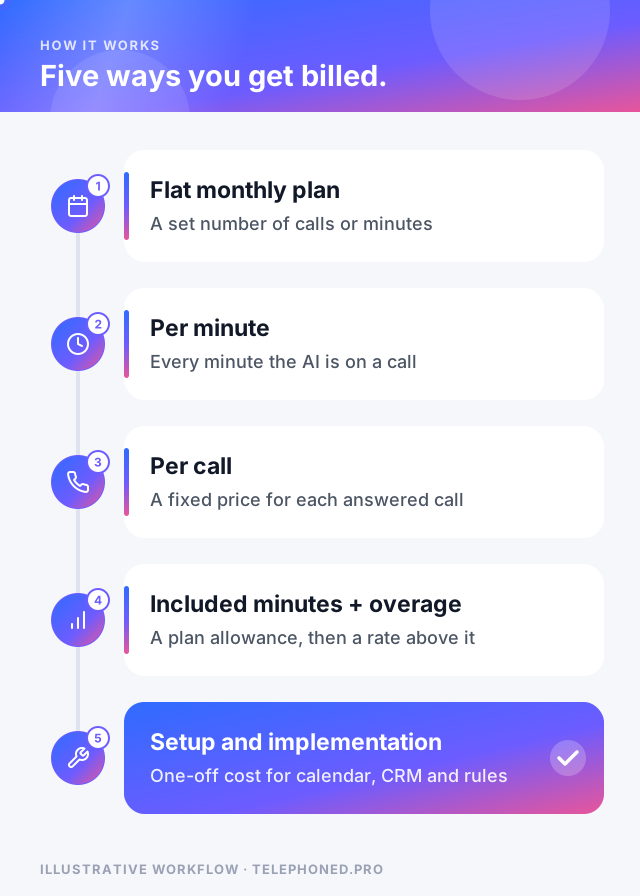
Providers mix and match five pricing models. Two plans with the same headline price can cost very different amounts once your real call volume runs through them.
The comparison that matters is cost per outcome, not just cost per month. An AI receptionist answers every call at once and around the clock. A live answering service adds people, usually at a higher monthly price. An in-house receptionist brings judgment and relationships, but one person covers about 40 of the 168 hours in a week.
| Option | Typical cost | Coverage | Books into your calendar |
|---|---|---|---|
| AI receptionist | About $25–$300/month, plus any setup fee | 24/7, many calls at once | Yes, when connected |
| Live answering service | About $250–$450/month, rising with minutes | Depends on plan, often 24/7 | Sometimes |
| In-house receptionist | About $3,168/month median wage, before benefits and taxes | Staffed hours, one call at a time | Yes |
“Round-the-clock human coverage takes about 4.2 full-time roles: 168 hours a week divided by a 40-hour week, before breaks, sickness and holidays.”
The cheapest model on paper is not always the cheapest in practice. The right choice depends mostly on how many calls you receive, how long they last and how predictable your volume is from month to month.
Two businesses with the same number of calls can receive very different quotes. These are the factors that usually move the price:
It is worth it when the calls it answers are worth more than it costs. For most service businesses that comes down to one question: how many calls a month currently reach voicemail or go unanswered, and what is one of those calls worth if it turns into a booked job, appointment or client? If a single recovered booking covers the monthly price, the decision is usually straightforward. If you rarely miss calls and callers always need a person, a lower-cost plan used only for after-hours and overflow calls may be the better fit.
Take last month's call log and count three numbers: total calls, average call length, and how many calls arrived outside staffed hours or went unanswered. Multiply calls by length to get minutes, then price that against each plan's model, including overage. Then compare it with what an unanswered call costs you: if one missed job or appointment is worth more than a month's subscription, the calculation is usually straightforward.
Telephoned.pro quotes each setup individually: a one-off implementation fee to build the receptionist around your calendar, CRM and call rules, plus a monthly subscription based on call volume and integrations. The first 30-minute consultation is free and comes with no commitment.
Keep reading
Bring one real workflow. We will show you how calls, follow-up and scheduling could connect for your business.