US business call workflows
AI receptionist for restaurants
with a clear next action.
An AI receptionist for restaurants handles approved routine phone inquiries, captures reservation or event requests and routes exceptions to your team. Telephoned.pro scopes the conversation around your restaurant’s current information and verified booking process. Table availability, dietary safety, order changes and event commitments must follow your actual operating rules rather than a plausible answer generated during a call.
Review AI Receptionist for Small Business: 24/7 Call Coverage. A related guide to check alongside this page is AI Receptionist for Business: 24/7 Answering & Booking.
Workflow review
Separate a table request from an event or active-order issue
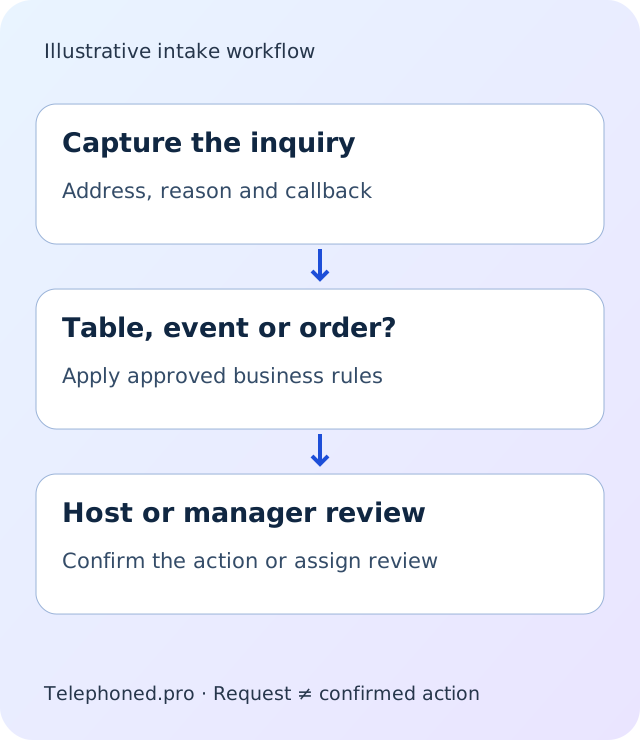
Illustrative scenario: a caller asks about a reservation while the host is seating guests. The assistant can identify the requested date, party size and callback details, then use the approved next step. It should not promise a table simply because a general calendar appears open. Your reservation system and restaurant rules determine whether the booking is accepted.
A private-event inquiry, a question about an existing reservation and a problem with an active order need different destinations. Your team may choose to automate only routine information and request capture. Defining that limited scope can be more useful than assuming every phone conversation belongs in the same booking flow.
Workflow review
Design the restaurant phone workflow around verified information
Start with the reason for the call and the location if your business has several restaurants. Use current approved information for hours, directions and general policies. Identify who maintains that information when holiday hours, menus or service arrangements change. A stale answer can create a poor experience even when the assistant sounds natural and confident.
For a reservation request, capture only the information your approved process needs. Party size, requested date and time, contact details and relevant request notes may affect the next step. Larger parties, special arrangements or private events may need a manager rather than an automatic table booking. Keep those categories separate and do not invent availability or policy exceptions.
A booking is confirmed only when the actual reservation action succeeds. If no supported connection is verified, the workflow can capture a request for staff review instead. Make that limitation clear to the caller. A requested time, a waitlist inquiry and an accepted reservation are different outcomes and should remain distinct in the record your host team receives.
Your call flow
Review a normal request and an exception
Bring your current tools and operating rules. We will distinguish confirmed actions from requests that need your team.
Workflow review
Route dietary questions and service problems to staff
A caller may ask about an allergy, ingredient substitution or whether a meal is safe for them. Those questions require the restaurant's approved process and the appropriate person. The assistant should not infer ingredient safety, guarantee the absence of cross-contact or improvise advice. It can route the question and preserve the caller's request for the team to address.
Active-order changes, payment concerns and complaints may also need a manager or another responsible staff member. Define the escalation path and fallback when that person cannot answer. Do not imply an order was changed or a refund approved unless the authorized process confirms it. The caller needs an accurate next action, and the team needs the request attached to the right context.
Review this workflow with your team.
Bring one routine request and one exception. Review existing-number forwarding where supported, plus AI transparency.
Workflow review
What to check before choosing restaurant phone automation
Bring the call categories you want covered, the source of current hours and policies, and the reservation rules for ordinary and unusual requests. Identify which actions need a host or manager. If several locations have different hours or booking practices, explain how the caller reaches the correct restaurant and who maintains each set of instructions.
Test a routine information call, a standard reservation request, a larger-party inquiry and someone changing an existing booking. Add a dietary-safety question, an active-order issue and an unavailable reservation system. Inspect the saved result and the explanation given to the caller. Check that a captured request has not been described as a completed reservation or approved order change.
Verify the exact supported actions in your reservation, CRM or other operating account. A generic calendar integration does not establish restaurant table inventory or policy compatibility. Ask how conflicting requests, retries and duplicate bookings are handled. Use fictional guests during discovery so the demonstration does not require private payment information or real customer records.
Workflow review
Start with routine requests while staff owns hospitality decisions
A narrow first workflow might answer approved questions and route reservation requests while the host team continues managing tables. Another restaurant may want event inquiries captured for a manager. Choose the scope because its next action is clear and reviewable. Do not count every answered call as an additional seated guest or a completed sale.
Follow-up should reflect current status. A guest who already changed or cancelled a booking should not receive an unchanged confirmation. A manager handling a complaint should remain the owner of that conversation. These reconciliation rules matter when phone intake connects with other communication channels and reservation records.
Bring one normal request and one exception to the demo. We can review which information is safe to answer directly, which actions need verified connections and where your staff should take over. Your restaurant retains control of dietary questions, guest concerns and operating commitments. The proposed workflow should support that responsibility with clear boundaries rather than promise to replace it.
Before you decide
Questions about the proposed setup
Only the verified reservation process can confirm a table. Otherwise the assistant should capture the preferred time as a request awaiting staff confirmation.
It should not infer dietary safety. Follow the restaurant-approved process and route those questions to the appropriate staff member.
That requires a separately scoped and verified authorized process. Ordinary answering should not imply an order change has completed.
Want to hear it on your own calls?
Secure your spotReview the workflow
around your business.
Bring a typical call and one exception. We will explore the right scope, dependencies and staff handoffs before you decide.