Capture the caller’s request
Listen first Record a reliable callback number, request and relevant location. Ask for missing information rather than guessing.
AI phone answering · US businesses
An AI phone answering service connects incoming calls on your existing business number with lead capture, qualification, calendar booking and a clear handoff to your team. Telephoned.pro configures the coverage and follow-up around your business rules, including when a person should take over.Bring your current number, service area, staffed hours and calendar to a demo. We will review which call flows and connections fit your business before you roll them out.
Review AI Receptionist for Business: 24/7 Answering & Booking. A related guide to check alongside this page is AI Receptionist for HVAC Companies: 24/7 Call Answering.
Where to start
An AI phone answering service can support after-hours intake, overflow calls and routine scheduling questions. The useful question is what happens after the greeting: which details are captured, where they go and who owns the next action.
For a US service business, the call flow may need a ZIP code, the customer’s requested service, the relevant branch and a callback window in the customer’s time zone. Agree on those fields before connecting the phone flow to your operating tools.
Existing-number routing, supported languages, calendars and CRM connections depend on the setup. Ask for a demonstration with your actual requirements rather than assuming every phone system or integration behaves the same way.
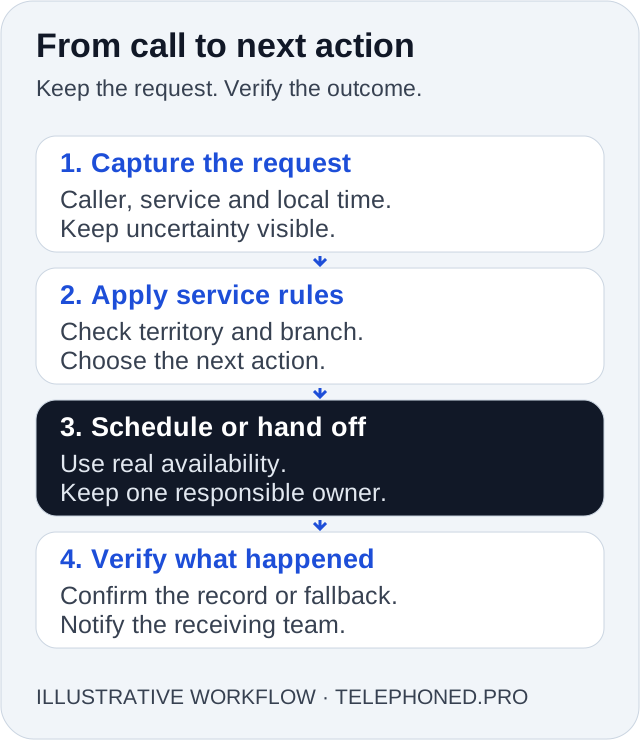
From call to next action
Listen first Record a reliable callback number, request and relevant location. Ask for missing information rather than guessing.
Apply your rules Match the request to your service area, branch hours and approved escalation path. Keep uncertain cases visible to staff.
Use real availability Where scheduling is supported, use the connected calendar’s rules. Otherwise create a callback or handoff with one owner.
Confirm what happened Confirm an appointment only after the calendar accepts it. If a transfer or connection fails, preserve the request and use the agreed fallback.
See the workflow
Secure your spot and bring an after-hours inquiry, a busy-period call or a scheduling request. We will work through the capture, routing and next action for your business.
US service-business examples
A caller asks about a repair in a neighboring ZIP code. The flow checks the approved service area before offering the next step.
A returning customer asks about an existing appointment. Capture enough context for the service advisor and avoid creating a duplicate request.
A caller needs the right branch and a callback at 9 a.m. Pacific time. Preserve both the branch and the requested time zone.
HVAC and home services
For HVAC and home service companies, phone coverage is seasonal and unforgiving. Calls spike during heat waves and cold snaps, the team is on the tools rather than at a desk, and the caller who reaches voicemail simply calls the next company on the list. An AI phone answering service absorbs that pattern: it answers every call instantly during rush periods, overnight and on weekends, and it asks the questions a dispatcher would ask — system type, symptoms, address, and how urgent the job is.
Because it books against real availability, a routine maintenance request lands in a normal slot while a no-heat or no-cooling call is flagged as urgent and pushed straight to the on-call technician. Callers get direct answers about your service area and what a diagnostic visit involves, and every call ends with a summary and transcript so the crew arrives already knowing the job.
On a typical home-service call
Examples of how common HVAC, plumbing, electrical and roofing calls are carried end to end.
Answered in seconds while the line rings out elsewhere. The system type, address and urgency are captured, the job is booked against open slots, and same-day emergencies are escalated to the on-call technician with the transcript attached.
Explains what a tune-up visit covers, checks real availability, books the appointment and sends a confirmation — no string of callbacks to lock in a time.
Answered directly from your service-area list, so out-of-zone callers are told so politely and in-zone callers move straight to booking.
Coverage continues when the office is closed: emergencies are flagged for urgent callback, and routine requests are booked into the next open day.
What stays with people
A caller may ask for a person, describe something outside the approved service scope or provide conflicting information. Define who receives that case, what context travels with it and what happens when nobody answers.
AI phone answering is one part of the operating workflow. Your team remains responsible for service decisions and exception handling. During the demo, ask to see an unanswered transfer and an unavailable calendar as well as the normal path.
Bring one routine request and one exception. Review existing-number forwarding where supported, plus AI transparency.
From ring to next step
1. Answer Your existing number routes to the receptionist for all calls, overflow or after-hours coverage, according to the setup you choose.
2. Qualify The receptionist asks your approved questions, captures contact details and checks service area, request type and urgency before choosing a next step.
3. Book or hand off Eligible appointments are booked against the availability and rules agreed for your calendar. If booking cannot be confirmed, the request needs a callback or staff review; the caller should not receive a false confirmation.
4. Summarize The call summary carries the caller’s details, request and next action to the appropriate team workflow. Confirm the supported calendar and CRM connections during your demo.
Call handling
Routine inquiries, lead qualification and appointment requests can follow the information and rules you approve. Your team defines which services can be booked and which questions the receptionist may answer.
Urgent calls, requests outside the approved scope and situations requiring judgment go to a person under your escalation rules. Define the on-call contact, what happens when a live transfer is unanswered, and who owns the callback. Automated intake does not replace a specialist’s decision.
Call handling
Compare the outcome of the call, not just whether it was answered. A traditional answering service may take a message, transfer a call or offer scheduling under its service agreement. An AI phone answering service applies configured intake and booking rules, with people handling exceptions.
Use the same scenario to compare qualification, a completed calendar booking, the summary and the no-answer handoff. Coverage and capabilities depend on the agreed setup; ask what is included before choosing.
Call handling
Telephoned.pro pricing is a one-time setup fee plus a monthly subscription, quoted after a free 30-minute demo. There is no free plan and no long-term contract. The demo maps your call handling and tools so the quote reflects the workflow you need.
Before the demo
Bring your current number and phone provider to the demo. The routing method depends on your phone setup; confirm how calls will reach the service and how staff can take over.
Yes. You can route only the calls your team cannot reach, for example after a set number of rings, when every line is busy or outside staffed hours. The AI phone answering service then covers overflow without replacing your front desk.
Define the ZIP codes, towns or territories you actually serve. A useful flow checks those rules and sends uncertain cases to a person instead of promising service.
Scheduling depends on the calendar connection and your availability rules. Ask to see a real appointment write, a rejected write and the fallback for each.
Agree on the information to capture, the next staffed callback window and the approved escalation path. After-hours intake should not imply that a team member is available when they are not.
Test the same calls with each option: a new inquiry, a returning caller, an unavailable staff member and a failed booking. Compare the verified next action and the context available to your team.
Yes, urgent calls can be escalated under your agreed rules. Identify the on-call contact and the fallback when nobody answers; a transfer attempt is not the same as an accepted handoff.
Keep the request pending and route it to the agreed callback or staff-review workflow. Confirm the failure path during the demo so callers are not told an appointment exists before the calendar accepts it.
No. The 30-minute demo is free. The implemented service has a one-time setup fee plus a monthly subscription, quoted after the demo, with no long-term contract.
Secure your spot and bring one real scenario. We will review the caller details, routing rules and handoff your team needs.
Keep exploring
Guides picked for this page, plus the services and decisions that connect to it.
An AI receptionist call transfer connects a caller to the appropriate person under your approved rules.