Best AI Virtual Receptionist in 2026: Options Compared
Compare the four types of AI virtual receptionist available to US businesses in 2026, what 24/7 coverage and live transfer really involve, and how to test a provider.
Read the guide →AI Receptionist
The best AI receptionist voice isn't the fanciest. Learn what makes callers trust an AI voice, how to test it in a demo, and whether it should say it's AI.
AI-assisted editorial guide from Telephoned.pro, a provider of AI receptionist services. It answers questions US searchers ask about AI receptionist voices and cites published research and FCC documents. It is not legal advice; confirm obligations for your business with counsel.
The best AI voice for a virtual receptionist is not the one that sounds most impressive in a demo clip. It is the one that answers quickly, lets callers interrupt, pronounces names and addresses correctly, and is honest about being automated when asked. Callers forgive a slightly synthetic tone; they do not forgive long pauses, being talked over or having to repeat their address three times.
That is good news when you are comparing providers, because those qualities can be tested in a few minutes with your own phone. This guide explains what makes an AI receptionist sound human to callers, how to test it, and where honesty about automation fits.
People judge a phone conversation mostly by its rhythm. A 2009 study published in the Proceedings of the National Academy of Sciences compared conversations in 10 languages, from major world languages to small indigenous communities, and found the same pattern everywhere: speakers avoid talking over each other and keep the silence between turns short. A voice that waits too long to respond, or keeps talking when the caller starts to speak, breaks that rhythm immediately, however natural the voice itself sounds.
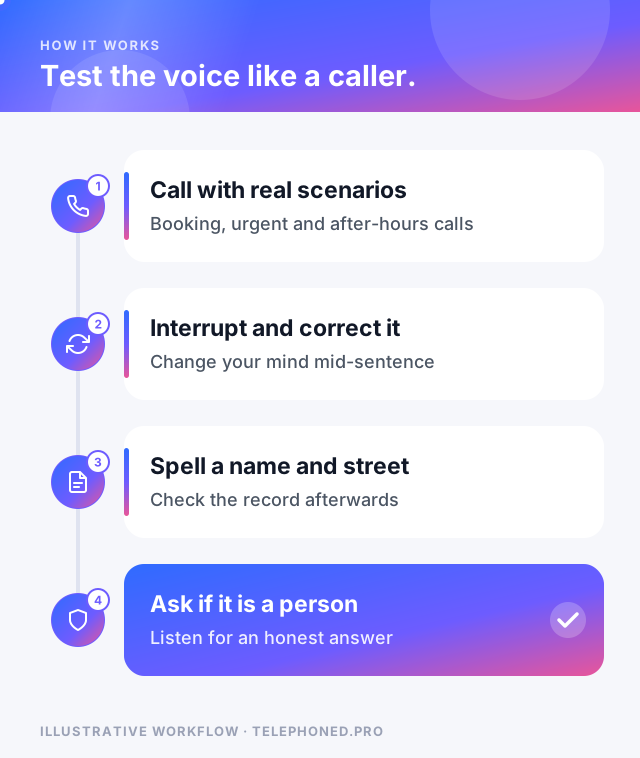
| Factor | Why it matters | How to test it |
|---|---|---|
| Response timing | Long pauses feel like a dropped call or a confused system | Ask a simple question and notice how quickly the reply starts |
| Interruptions | Callers correct themselves mid-sentence all the time | Change the appointment day while the AI is still talking |
| Names and addresses | A misheard street means a technician at the wrong house | Spell a surname and a local street, then check the record |
| Noise and accents | Real callers ring from cars, job sites and busy kitchens | Call on speakerphone with background noise |
| Tone for urgent calls | A calm, clear voice reassures someone with an emergency | Describe a burst pipe at 9 p.m. and listen to the escalation |
| Honesty | Trust drops if callers feel misled | Ask directly whether you are speaking to a person |
Because rhythm is the first thing a caller notices. In the PNAS study, the average gap before a reply varied between languages, but every language clustered within about a quarter of a second of the shared mean, and in every one people kept those gaps short. On the phone, where there is no body language to fill a silence, a slow reply quickly feels like a problem.
“Callers forgive a slightly synthetic voice. They don't forgive waiting, being talked over or repeating their address three times.”
The practical lesson for buyers: when you compare providers, judge the conversation, not the voice sample on the website. A pleasant recorded greeting tells you nothing about how the system behaves when a caller interrupts, mumbles a ZIP code or asks something unexpected.
Yes, when a caller asks, and many businesses choose to say so up front. In February 2024 the Federal Communications Commission confirmed that AI-generated voices count as artificial voices under the Telephone Consumer Protection Act, which means outbound calls using them generally need the called person's prior consent. Answering calls that customers place to you is a different situation, but the principle behind the ruling is worth following everywhere: callers should not be misled about who they are talking to.
Telephoned.pro's AI receptionist identifies itself as an automated assistant when asked and offers a route to a person whenever your rules allow it. In our experience a clear, honest answer keeps the conversation moving; the call goes wrong when the system dodges the question.
Not necessarily. A voice so polished that callers believe they are speaking to a member of staff can backfire when the conversation reaches something the AI cannot handle. A clear, warm voice that is honest about being automated, answers quickly and hands over smoothly usually earns more trust than a perfect imitation. Choose the provider whose calls end with the right outcome: a confirmed booking, an urgent escalation or a clear callback time.
Keep reading
Bring one real workflow. We will show you how calls, follow-up and scheduling could connect for your business.