Best AI Virtual Receptionist in 2026: Options Compared
Compare the four types of AI virtual receptionist available to US businesses in 2026, what 24/7 coverage and live transfer really involve, and how to test a provider.
Read the guide →AI Receptionist
The main benefits of a 24/7 AI virtual receptionist for US businesses, from after-hours bookings to urgent escalation, plus the limits to plan for.
AI-assisted editorial guide from Telephoned.pro, a provider of AI receptionist services. It answers a question US searchers ask and describes general capabilities and limits; it contains no customer results or industry statistics. Confirm specific features with any provider you evaluate.
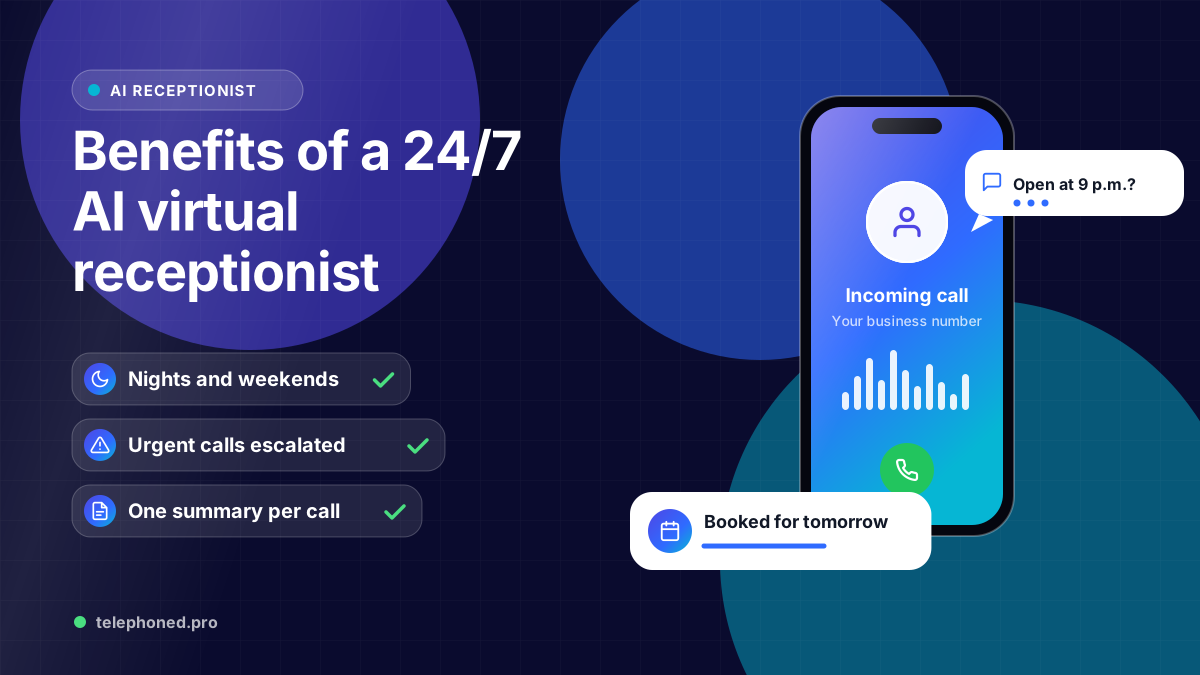
The main benefit of a 24/7 AI virtual receptionist is that every caller reaches a useful response, whatever the time. Evening, weekend and holiday calls are answered on your existing business number, routine requests are booked straight into your calendar, urgent ones are escalated to whoever is on call, and your team starts the next day with a written summary instead of a voicemail inbox.
That matters because people call when the problem happens or when they finally have a free moment, which is often outside office hours. A caller who reaches voicemail can simply dial the next business in the search results. Below are the benefits worth evaluating, and the limits you should plan for.
An AI virtual receptionist answers at 2 a.m. exactly as it does at 2 p.m. Callers can explain what they need, ask approved questions and leave with a clear next step. For businesses that receive evening or weekend demand, such as home services, healthcare intake, legal intake and property management, this is usually the biggest change.
When the receptionist is connected to your calendar, it can offer real availability and book the appointment during the call. That avoids the next-morning callback, when the caller may already have booked elsewhere. Booking rules, such as notice periods, appointment lengths and service areas, are set by you and followed every time.
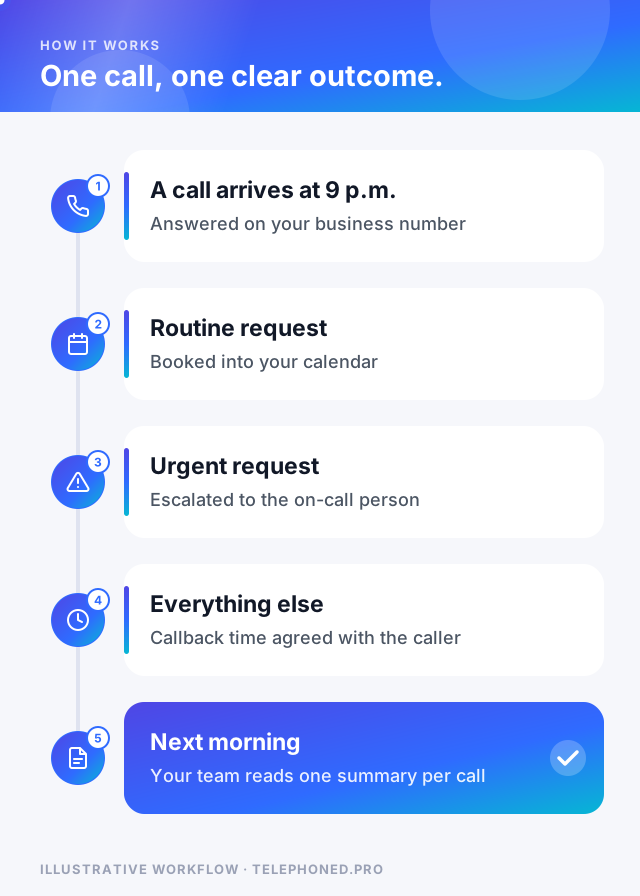
A 24/7 receptionist does not have to decide everything on its own. You define which situations count as urgent and who is on call, and the receptionist escalates those calls with the details already captured. A good setup also defines a backup contact if the first person does not respond, so an emergency is not left waiting.
Round-the-clock coverage is not only about nights. Many businesses route calls to the AI receptionist only when nobody answers within a set number of rings, or when every line is busy. Your team keeps the phones during the day, and the calls they cannot reach are still answered.
Each conversation can produce the same structured record: who called, why, what was decided and what happens next, with a transcript attached. That makes follow-up easier to assign and gives you a reliable picture of call volume and outcomes, including at times when nobody was in the office.
Staffing phones around the clock means shifts, cover for sickness and holidays, and paying for quiet hours. An AI receptionist is typically priced as a subscription based on call volume and integrations, often with a setup fee, so overnight and weekend coverage does not require extra hires. Compare the full cost of each option against the calls you actually receive.
| After-hours call | Voicemail | 24/7 AI receptionist |
|---|---|---|
| Who answers | Nobody; the caller leaves a message | An AI receptionist trained on your services and rules |
| Routine booking | Waits until the next business day | Booked into your real calendar during the call |
| Urgent request | Heard when someone checks messages | Escalated by your rules to the person on call |
| What the caller is told | Nothing beyond the greeting | A clear next step and callback time |
| What your team sees in the morning | Audio messages to listen through | One written summary per call, with the outcome |
Round-the-clock answering pays off fastest where new work arrives outside office hours and the caller is ready to act. A homeowner with a burst pipe at 9 p.m., a family with no heat on a January Saturday, a new dental patient booking after work, or a prospective legal client calling the evening after an accident will usually try the next business in the search results if nobody answers.
Covering every hour of the week with people takes far more than one hire: 168 hours divided by a 40-hour week is about 4.2 full-time roles before breaks, sickness and holidays, and the median US receptionist earns $38,010 a year before benefits and payroll taxes, according to the US Bureau of Labor Statistics. An AI receptionist is typically priced as a monthly subscription based on call volume and integrations, often with a setup fee. For a full breakdown of pricing models and ranges, see our guide to what an AI receptionist costs in 2026.
Keep reading
Bring one real workflow. We will show you how calls, follow-up and scheduling could connect for your business.