US business call workflows
AI receptionist for medical practices
with a clear next action.
An AI receptionist for medical practices can support a scoped administrative intake and staff-routing workflow. Telephoned.pro reviews the approved questions, scheduling requirements and supported connections with your practice before implementation. Clinical advice, patient triage and care decisions remain with qualified staff. This page makes no HIPAA, BAA or other compliance certification claim; confirm the requirements of any proposed patient-data workflow directly.
Review AI Automation for Healthcare Clinics. A related guide to check alongside this page is AI Receptionist for Dental Practices: Answer & Book 24/7.
Workflow review
Begin with administrative requests, not patient triage
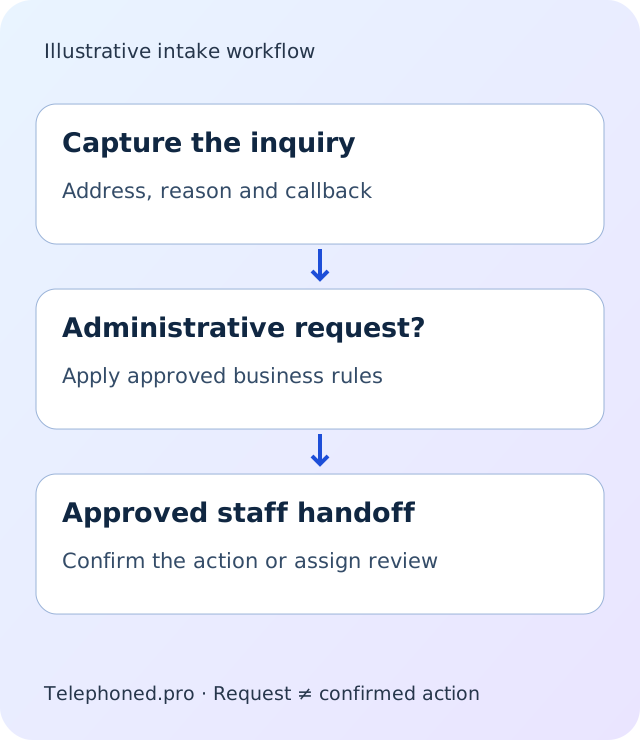
Illustrative scenario: someone calls while the reception team is helping patients and asks how to request an appointment. A bounded workflow can identify the administrative purpose, capture the approved callback information and explain the practice's next step. It should not decide whether symptoms are urgent, recommend care or infer that an appointment is clinically appropriate.
A new appointment inquiry, an existing patient reschedule, a records request and a question for a clinician need different ownership. Your practice decides which information may be collected and which requests must go directly to staff. Answering a call does not establish a suitable clinical or privacy process. Those boundaries need explicit review before any connection to patient systems is considered.
Workflow review
Build a practice-approved administrative call flow
Start with a clear greeting and the minimum approved information needed to route the request. Establish whether the person is asking about general administration or needs the practice's clinical contact path. Use the questions and wording supplied by the practice. Do not ask the assistant to interpret symptoms, gather an unrestricted medical history or decide what treatment a caller needs.
For appointment administration, identify the relevant location and request type. An initial inquiry, established-patient visit and specialist appointment may have different prerequisites. Referral, authorization, identity or staff-review requirements must remain in the approved process. If a requirement is unresolved, capture a request for review instead of implying that the caller is eligible or cleared to attend.
Confirm a scheduling action only after the authorized system accepts it. A preferred time, a callback request and an actual appointment are distinct statuses. If no suitable supported connection has been verified, the workflow must say that staff confirmation is needed. The internal record should preserve what the caller requested and what was actually promised, with a responsible owner for anything unfinished.
Your call flow
Review a normal request and an exception
Bring your current tools and operating rules. We will distinguish confirmed actions from requests that need your team.
Workflow review
Keep clinical and urgent requests on the approved human path
A caller can shift from an administrative question to a concern about symptoms, medication or treatment. Your practice supplies the approved escalation and emergency wording. The assistant should not diagnose, interpret prescriptions, recommend a response or decide the urgency of care. Its role is limited to the administrative scope and the routing instructions that have been agreed.
Define the fallback when the intended staff member cannot answer. An unanswered transfer is not evidence of clinical review. The caller must receive the approved explanation, and the practice needs an accountable next action. Do not imply that a clinician has seen a message or that waiting is safe. Review these scenarios with the appropriate practice personnel before any live use.
Review this workflow with your team.
Bring one routine request and one exception. Review existing-number forwarding where supported, plus AI transparency.
Workflow review
What to check before choosing medical administrative automation
Bring the administrative call categories, locations, staffed hours and current handoff process. Identify exactly which requests can be handled without clinical judgment and which must reach staff. Explain the scheduling prerequisites and the source of authoritative information. A platform logo does not establish that a particular patient workflow or account action is suitable.
Use fictional examples for a general appointment inquiry, a reschedule request, a coverage question and a caller who asks for clinical advice. Add an unavailable calendar and an unanswered staff transfer. Review the resulting records and caller-facing language. Check that no clinical decision, eligibility statement or unsupported appointment confirmation was introduced.
Review information collection, access, retention, account permissions and contractual requirements before connecting real patient details. The published privacy policy and data-processing agreement are starting documents, not proof that every regulated workflow is supported. HIPAA and BAA statements require direct confirmation from the business before they can be used. No such certification or availability is asserted here.
Workflow review
Evaluate a limited scope with staff oversight
A first review can focus on whether routine administrative inquiries reach the correct owner with the approved details. Keep captured requests, confirmed appointments and completed visits separate. None of those measures establishes a clinical outcome or guaranteed commercial result. Define success using your practice's actual records and the responsibilities of the staff involved.
Communication after the call must use the current request status and approved preferences. A rescheduled visit should not keep generating the old reminder, and a clinical question should not become a generic new-patient follow-up. Stop rules, corrections and reconciliation are part of the scope rather than details to address after deployment.
Bring one ordinary administrative request and one difficult exception to a discovery call. We can discuss what should remain manual, what requires further technical validation and which facts must be confirmed before an implementation is considered. Your practice retains responsibility for care, identity, privacy and clinical escalation; the proposed automation stays within a clearly agreed administrative boundary.
Before you decide
Questions about the proposed setup
No. Clinical assessment, treatment advice and urgency decisions stay with qualified staff under the practice-approved process.
No. Confirm those requirements directly before considering a patient-data workflow. This page makes no certification or BAA-availability claim.
Only an approved, verified scheduling process can confirm an appointment. Unresolved prerequisites or failed writes must remain staff-owned requests.
Want to hear it on your own calls?
Secure your spotReview the workflow
around your business.
Bring a typical call and one exception. We will explore the right scope, dependencies and staff handoffs before you decide.