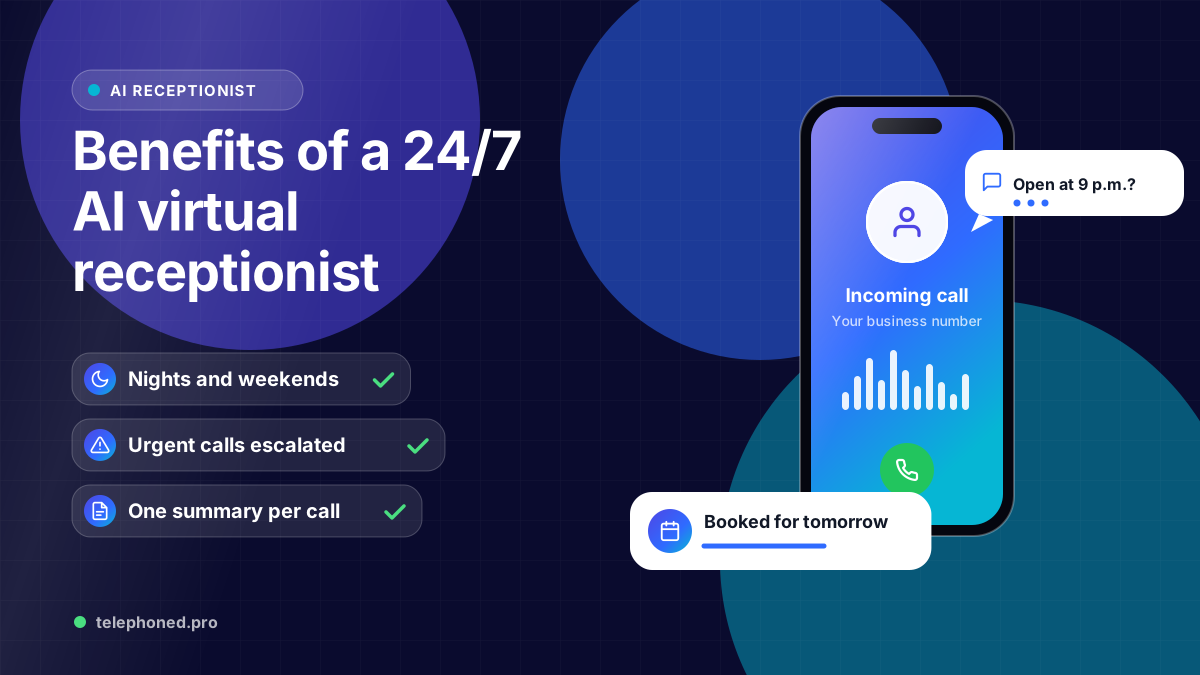
What Are the Benefits of a 24/7 AI Virtual Receptionist?
The main benefits of a 24/7 AI virtual receptionist for US businesses, from after-hours bookings to urgent escalation, plus the limits to plan for.
Read the guide →AI Receptionist
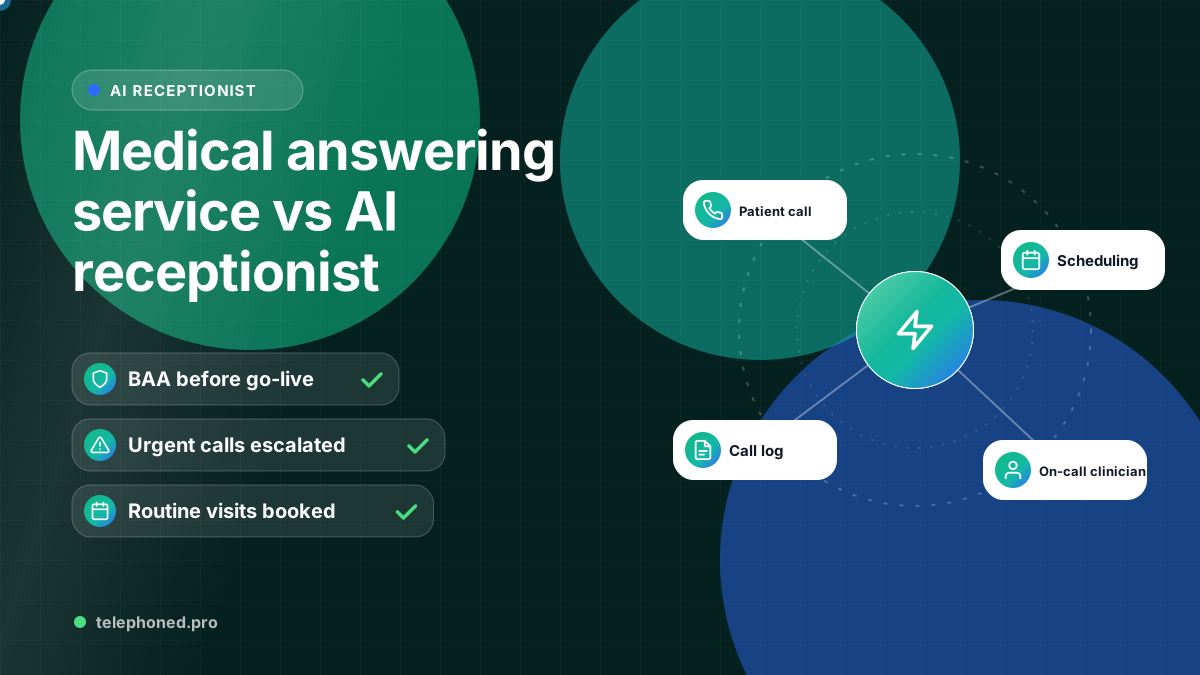
Medical answering service or AI receptionist? Compare privacy, BAAs, emergency escalation and after-hours coverage, with a checklist for any vendor.
For the wider workflow, explore AI Automation for Healthcare Clinics. For a related operating question, read AI Receptionist for Medical Practices.
AI-assisted editorial guide from Telephoned.pro, a provider of AI receptionist services. Breach figures come from the US Department of Health and Human Services Office for Civil Rights, and the business associate rules come from HHS guidance, all cited below. This article is general information, not legal advice, and it does not claim HIPAA compliance or business associate agreement availability for any provider, including Telephoned.pro. Scenarios are illustrative.
A medical answering service uses trained human operators to take messages and page your on-call clinician, while an AI receptionist answers every call at once, books routine appointments and hands anything clinical to your staff. The right choice depends less on the technology than on two things you can check: how the vendor protects patient information, and exactly what happens when a caller describes something urgent.
Many practices end up using both: AI for scheduling, refills and directions, people for clinical judgment. This guide compares the two on the points that matter in healthcare, then gives you a checklist to put to any vendor, human or AI. If you already know you want help with routine calls, see how an AI receptionist for medical practices is scoped before any patient data is connected.
Those numbers, from the HHS Office for Civil Rights report to Congress for 2024, are why privacy belongs at the top of the comparison. Most large breaches were hacking or IT incidents, and the largest single one hit a clearinghouse rather than a clinic. Every vendor that stores your patients’ messages is part of your attack surface, whether a person or software takes the call.
| Question | Medical answering service | AI receptionist |
|---|---|---|
| Who answers | A trained human operator, often in a shared call center | Software that speaks with callers and follows your approved script |
| Speed | Depends on staffing; queues form during flu season or storms | Answers at once, including several calls at the same time |
| Scheduling | Usually takes a message for staff to book later | Can book routine visits where a supported calendar connection is set up |
| Urgent symptoms | Operator follows your protocol and pages on-call | Follows fixed escalation rules: transfer, page or advise 911 |
| Clinical judgment | None; operators are not clinicians either | None; it should never give medical advice |
| Records | Message logs, sometimes call recordings | Transcripts, summaries and often recordings |
The overlap is bigger than vendors on either side admit. Neither option triages patients; both pass urgent calls to someone qualified. What really differs is speed, cost at volume, and how predictable the handoff is. An AI follows the same rule every time, while a good operator can sense panic in a voice that the words alone do not show.
Usually, yes. HHS defines a business associate as a person or company outside your workforce that performs services for you involving protected health information. An answering service that writes down a patient’s name, date of birth and reason for calling fits that description, and so does software that keeps a transcript. HHS guidance says covered entities need written assurances, normally a business associate agreement (BAA), before sharing that information.
Some vendors point to the “conduit” exception, which covers services such as the postal service that only carry information. HHS treats that exception as narrow: its guidance on cloud providers says a company that creates, receives or maintains electronic health information is a business associate, even if it cannot read encrypted data. A service that stores messages or recordings is not a mere conduit. Whatever a vendor tells you, confirm it in the contract and with your own compliance advisor.
“If a vendor keeps a record of what your patients said, ask for the BAA before you ask for the price.”
Bring one real scenario to your demo. We will review the intended next step, existing systems and human handoffs.
Secure your spot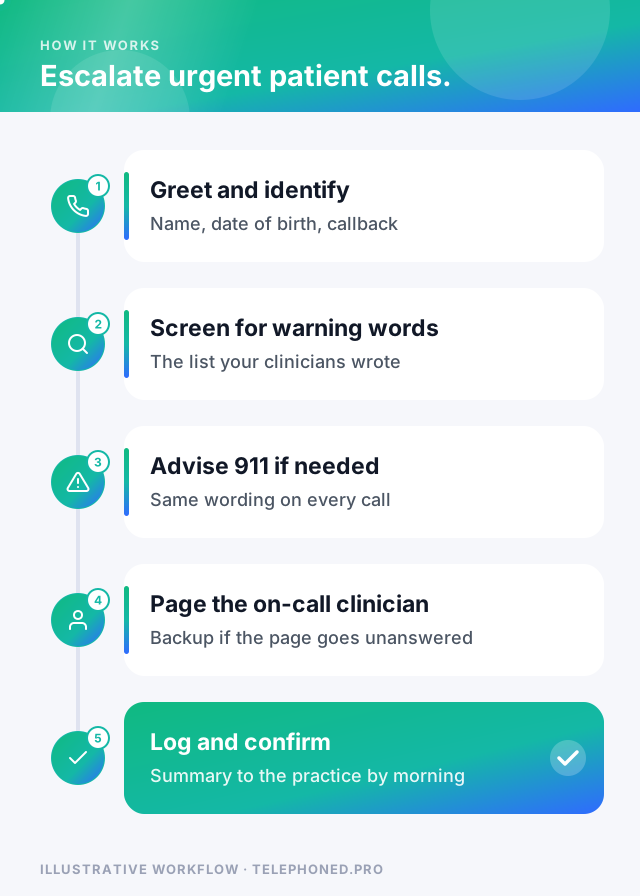
Picture a Saturday at 10 p.m. in Columbus, Ohio. A parent calls a pediatric practice because a toddler has a fever and is hard to wake. A medical answering service operator should follow the practice’s protocol and page the on-call pediatrician. An AI receptionist should do the same thing faster: recognize the warning words your clinicians chose, advise calling 911 for an emergency, and page or transfer to the on-call provider without making the parent repeat themselves.
| Your situation | Better fit | Why |
|---|---|---|
| Most calls are booking, rescheduling and directions | AI receptionist | Answers instantly and books into the calendar |
| Callers are often distressed or elderly and need reassurance | Medical answering service, or AI with a fast human handoff | A person can adapt tone and pace |
| Call volume spikes in flu season or after storms | AI receptionist | Handles many calls at once without a queue |
| A clinician must hear every after-hours call | Medical answering service paging on-call | Every call reaches a person |
| You want both routine automation and human backup | AI for routine calls, people for escalation | Each does what it is best at |
If you record calls, check consent rules as well as HIPAA; our call recording laws by state guide is a starting point. For dental offices, the same questions apply, with extra attention to emergency extractions and weekend swelling calls.
An AI receptionist is an administrative tool. It should not diagnose, recommend treatment, interpret test results or decide whether a symptom is serious beyond the fixed rules your clinicians set. It can mishear a name or a medication, so confirmation and readback matter. And no software replaces your own privacy review: Telephoned.pro makes no HIPAA or BAA claim on this page, and any patient-data workflow should be confirmed directly before it is switched on.
Keep reading
Bring one real workflow. We will show you how calls, follow-up and scheduling could connect for your business.
Keep exploring
The services and decisions that connect to this page.