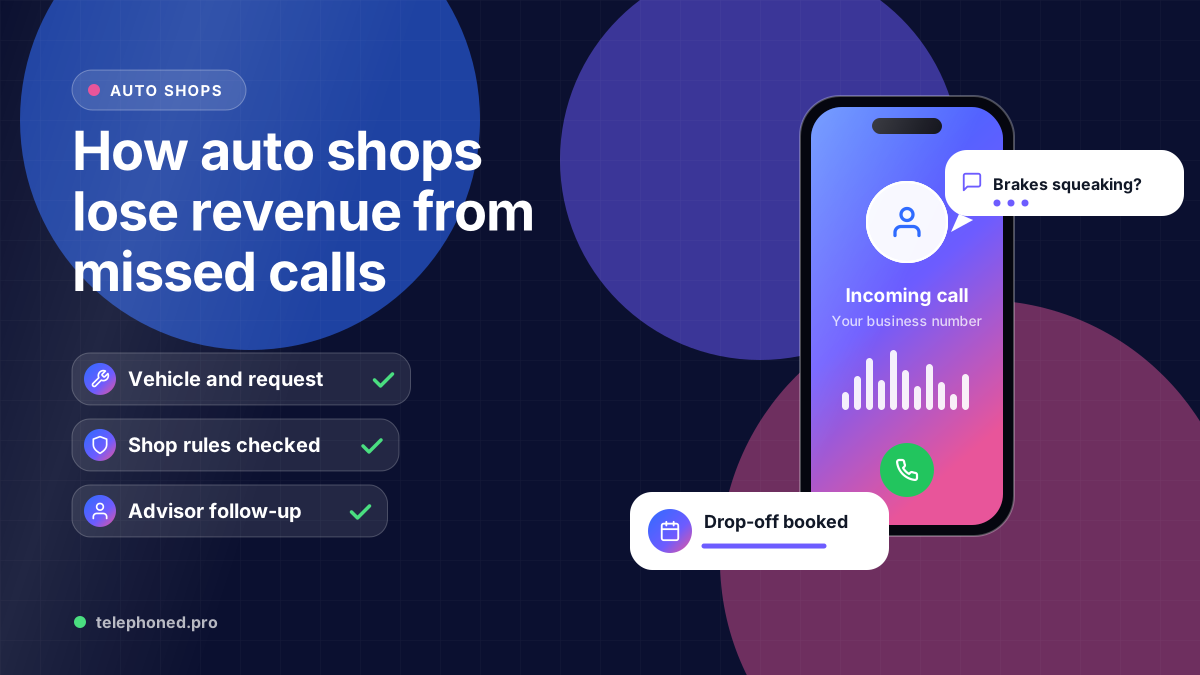
How Auto Shops Lose Work to Missed Calls
Audit repair inquiries, capture the right vehicle details and route appointment requests through shop approval, availability checks and an owned advisor handoff.
Read the guide →Home Services
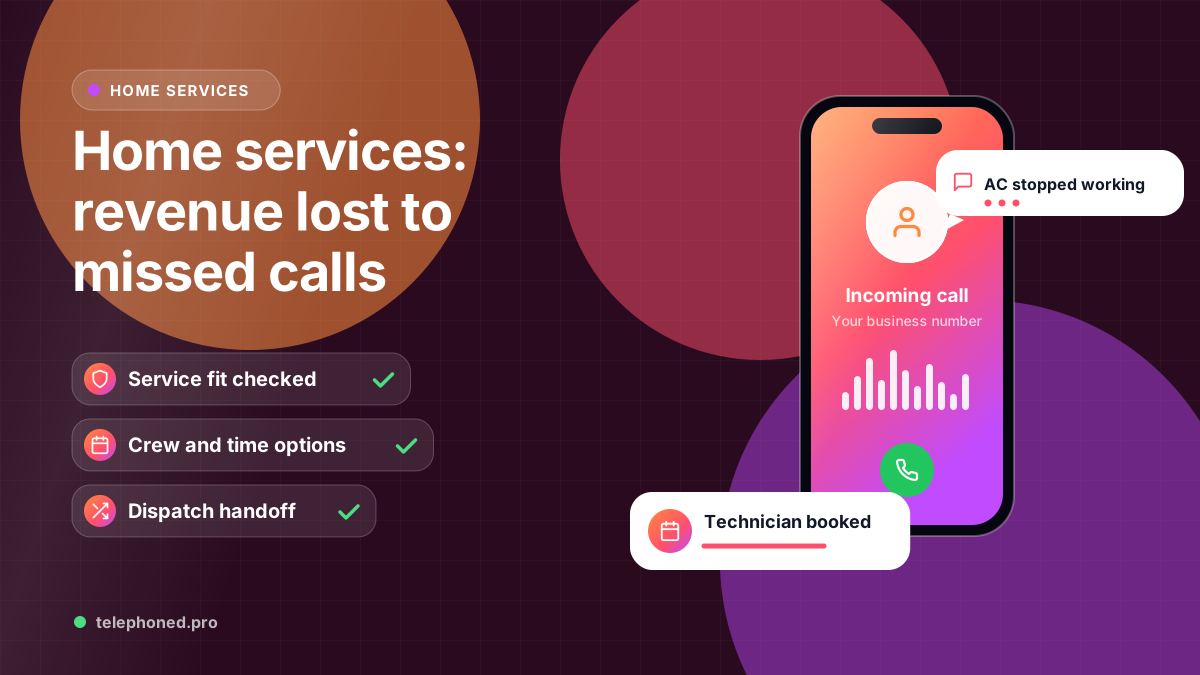
Audit qualified service inquiries and connect intake with approved service rules, crew availability and dispatch ownership without promising unconfirmed jobs.
For the wider workflow, explore AI Receptionist for Home Services: Never Miss a Job Call. For a related operating question, read AI Receptionist for Plumbers: What to Automate.
Prepared by the Telephoned.pro team with AI assistance and editorial review. Workflow examples are illustrative. Integration support, rollout timing and measured outcomes depend on the approved implementation.
Home services companies can lose useful inquiries when calls arrive during busy dispatch periods, after hours or while crews are already committed. A missed call is a signal to investigate, not proof that a job went to a competitor. A reliable recovery workflow checks whether the company can serve the request and assigns a next action that somebody actually owns.
Review a normal week and a peak-demand week separately. Group repeated attempts from the same customer and distinguish new work from existing-job updates, vendors and requests outside the company's scope. Include branch and time zone so a central report does not hide where inquiries are waiting.
A customer may be in the service area but still need work the company does not provide or a time the crew cannot cover. Approved intake questions should identify the request and route uncertainty to dispatch. Service rules, branch coverage, scheduling limits and escalation contacts need an owner who keeps them current.
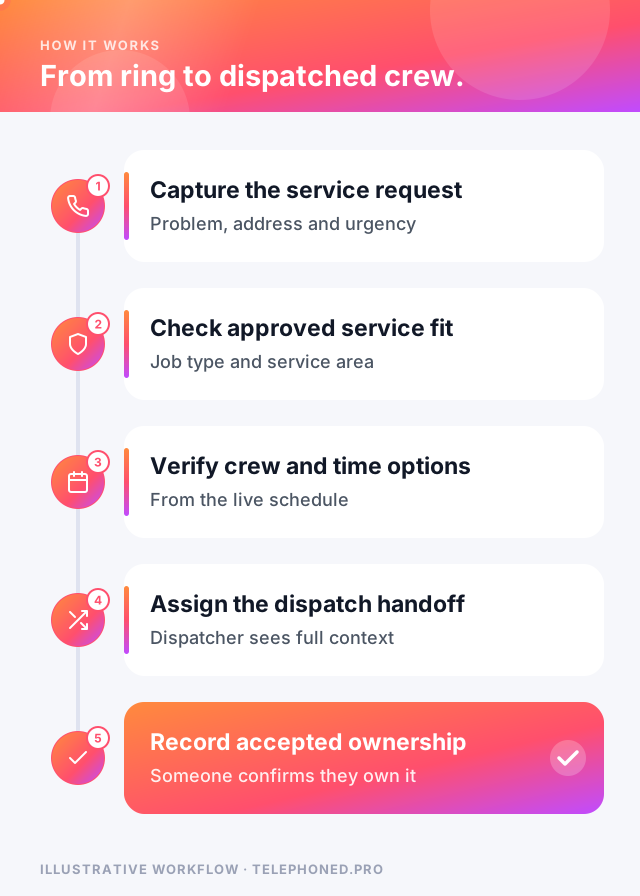
Automation can capture approved details and help route an inquiry through supported tools. It should not diagnose a hazardous condition, promise an emergency response or announce a crew arrival simply because the request sounds urgent. Use the company's approved escalation process and keep dispatch decisions with the responsible team.
A booking needs a successful scheduling write and any required staff approval. A transfer needs an accepted receiving owner. If the calendar is unavailable, the integration rejects the request or dispatch does not answer, keep the item unresolved and assign follow-up. Preserve the details already collected so the customer does not have to repeat the request.
Where the company uses messaging, confirmations, reminders and approved estimate follow-up should read the current job status. Stop or change a sequence after a cancellation, declined work, staff takeover or customer request to stop. Delivery alone does not prove the message produced a booking or prevented a no-show.
Bring one real scenario to your demo. We will review the intended next step, existing systems and human handoffs.
Secure your spotTrack qualified inquiries, callbacks completed, accepted handoffs, calendar-confirmed bookings and unresolved exceptions. Compare similar operating periods and note storms, seasonal demand, promotions and capacity changes. Link completed jobs to the business's records before reporting recovered revenue. An inquiry-value scenario remains an estimate.
The broader opportunity is to connect customer communication, qualification, scheduling, CRM records and dispatch administration. Start with one well-defined path and expand when the team can verify the process and maintain its rules.
| Moment | Why calls go unanswered | What helps |
|---|---|---|
| Storm or heat-wave week | Call volume spikes far above normal | Overflow answering and urgent-call rules |
| Evenings and weekends | Office is closed when problems happen | 24/7 answering with on-call escalation |
| Busy dispatch hours | Staff are coordinating crews | Automatic intake and callback scheduling |
| Technicians on the job | Owner-operators can't stop to answer | Capture, qualify and book while they work |
| Lunch and shift changes | Short gaps in phone coverage | Ring-no-answer forwarding to an AI receptionist |
A burst pipe at 9 p.m. or a failed air conditioner on the first hot Saturday of summer does not wait for office hours, and those callers are usually ready to book the first company that answers. The same is true of storm weeks for roofers, when a single day can bring more calls than a normal fortnight.
Use your own numbers rather than industry averages. Count unique service requests that went unanswered in a normal week and in a peak week, estimate the share that would have booked based on your usual booking rate, and multiply by the average ticket for those job types. The ROI calculator on this site runs that calculation with your assumptions. Licensed trades such as plumbing take years of apprenticeship to staff, according to the Bureau of Labor Statistics, so the calls your team already earns are worth protecting.
Review the results with dispatch and branch managers after the first busy week. Look at which calls were booked, which were escalated and which needed a callback, and adjust the rules before the next peak. The goal is a system your team trusts on its busiest day, not just its quietest.
Keep reading
Bring one real workflow. We will show you how calls, follow-up and scheduling could connect for your business.
Keep exploring
The services and decisions that connect to this page.