Missed Call Follow-Up: An Ownership Guide for US Businesses
Build a missed call follow-up workflow for your US service business: assign one owner, set callback rules and track inquiries through to a booked appointment.
Read the guide →Business Automation
Separate qualified inquiries from repeat calls, estimate potential missed-call value and connect follow-up to a clear owner, CRM record and outcome.
For the wider workflow, explore AI Receptionist & Automation Guides. For a related operating question, read Missed Call Follow-Up: An Ownership Guide for US Businesses.
Prepared by the Telephoned.pro team with AI assistance and editorial review. Workflow examples are illustrative. Integration support, rollout timing and measured outcomes depend on the approved implementation.
A missed call can be a lost opportunity, but it is not automatically a lost sale. Some callers are existing customers, suppliers, repeat inquiries or people outside your service area. A useful missed-call audit identifies the inquiries your team could actually serve, then follows what happened to them. The same method works for a single front desk, a regional service business or a company operating across multiple locations.
Start with your phone system's missed and abandoned call records for a normal operating week. Separate calls that reached voicemail from calls that disconnected in a queue, transfers that failed and requests that were answered but never assigned. These are different problems and may need different fixes.
Multiplying every missed call by an average sale value overstates the opportunity. A more useful scenario multiplies unique qualified inquiries by an assumed recovery rate, an assumed booking or sales conversion rate and an average transaction value. Use a range when the rates are unknown. This is potential gross sales value, not measured revenue or profit.
If you need a financial decision, include delivery costs, staff time, implementation effort and the value of the work your team can realistically fulfill. Review whether the average transaction is the first purchase or a longer-term relationship; mixing the two can make the estimate misleading. Replace assumptions with recorded outcomes as a pilot runs.
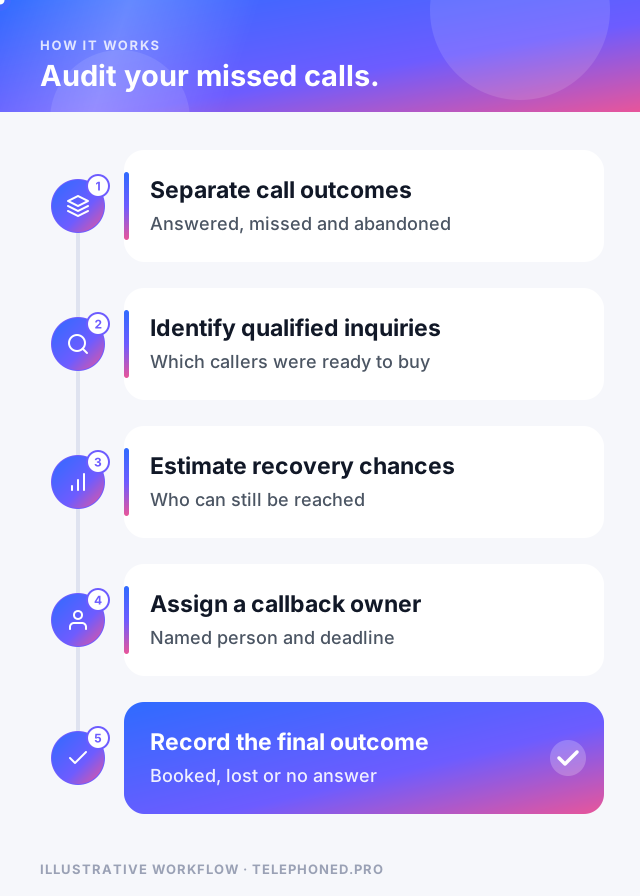
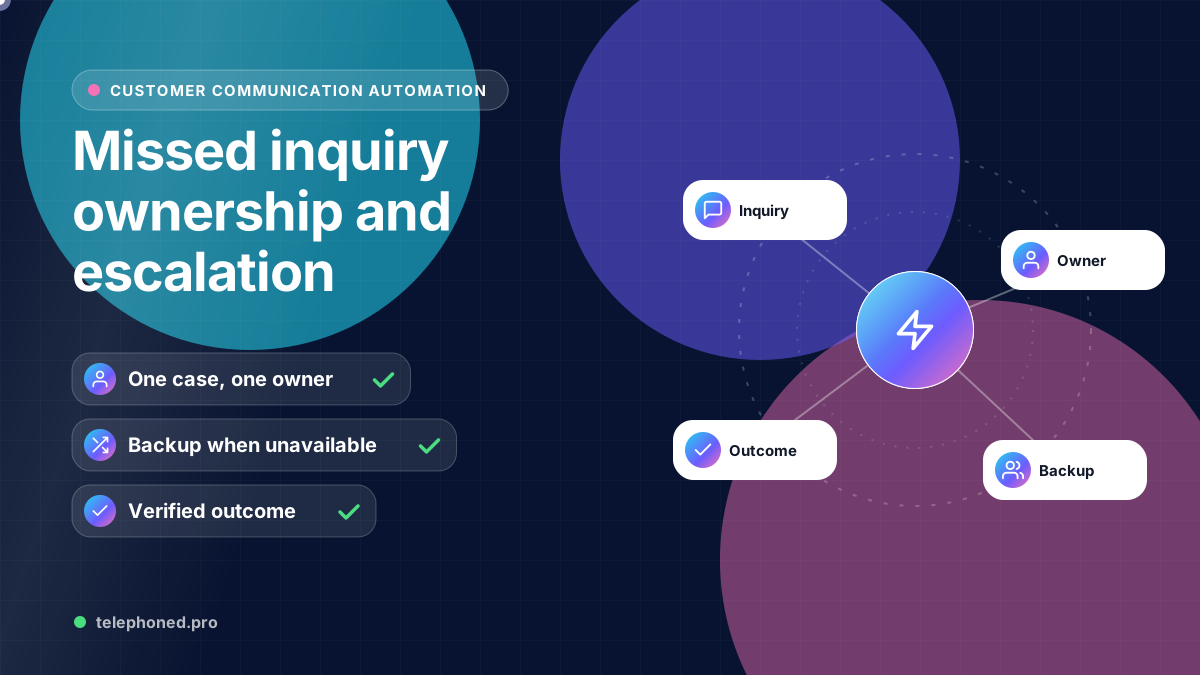
Answering or acknowledging an inquiry is only the first step. A useful workflow connects the caller's request to a record, a next action and an owner. Depending on the approved process, that may be a callback, a qualification question, an available appointment or a review queue. A request should remain open until the next action is confirmed or a person accepts responsibility.
Automation can help capture approved details, create or update a CRM record and queue routine follow-up. It should not promise an appointment when the calendar write fails or label an attempted transfer as a completed handoff. Give unresolved items a staff owner and an escalation path. Confirm messaging permissions and stop rules before sending automated follow-up.
Bring one real scenario to your demo. We will review the intended next step, existing systems and human handoffs.
Secure your spotA storm, holiday, promotion or staffing change can alter demand. Annotate those changes before attributing an improvement to automation. The goal is to recover useful inquiries and reduce avoidable administrative work, with evidence your team can review. Phone coverage, lead qualification, CRM updates and scheduling belong to the same operating process.
| Step | What to count | Example question |
|---|---|---|
| 1. Unique inquiries | Missed calls minus repeats from the same caller | How many different people called? |
| 2. Serviceable requests | Inquiries that match your services and area | How many could you actually help? |
| 3. Likely bookings | Serviceable requests times your usual booking rate | How many would normally book? |
| 4. Value | Likely bookings times average job value | What would those jobs be worth? |
| 5. Net value | Value minus delivery and staff costs | What would you actually keep? |
Working through these five steps with your own records gives a defensible number instead of a scary headline. It also shows where the gap really is: after hours, during peak weeks, or when one person is juggling the phone and customers in front of them.
Compare the net value from the table with the cost of each way to close the gap. Staffing phones around the clock takes about 4.2 full-time roles (168 hours a week divided by 40), and the median US receptionist earns $38,010 a year according to the Bureau of Labor Statistics. Answering services and AI receptionists cost far less per month but cover different needs. Our guide to AI receptionist pricing compares the options in detail.
“A missed call is not automatically a lost sale. Count the real inquiries first, then decide how much answering them is worth.”
Whatever you decide, repeat the audit a month after any change. The same five steps will show whether more inquiries were answered, how many became bookings and whether the improvement held through a busy period, which is the evidence you need before expanding coverage further.
Keep reading
Bring one real workflow. We will show you how calls, follow-up and scheduling could connect for your business.