How Home Services Companies Lose Jobs to Missed Calls
Audit qualified service inquiries and connect intake with approved service rules, crew availability and dispatch ownership without promising unconfirmed jobs.
Read the guide →Auto Shops
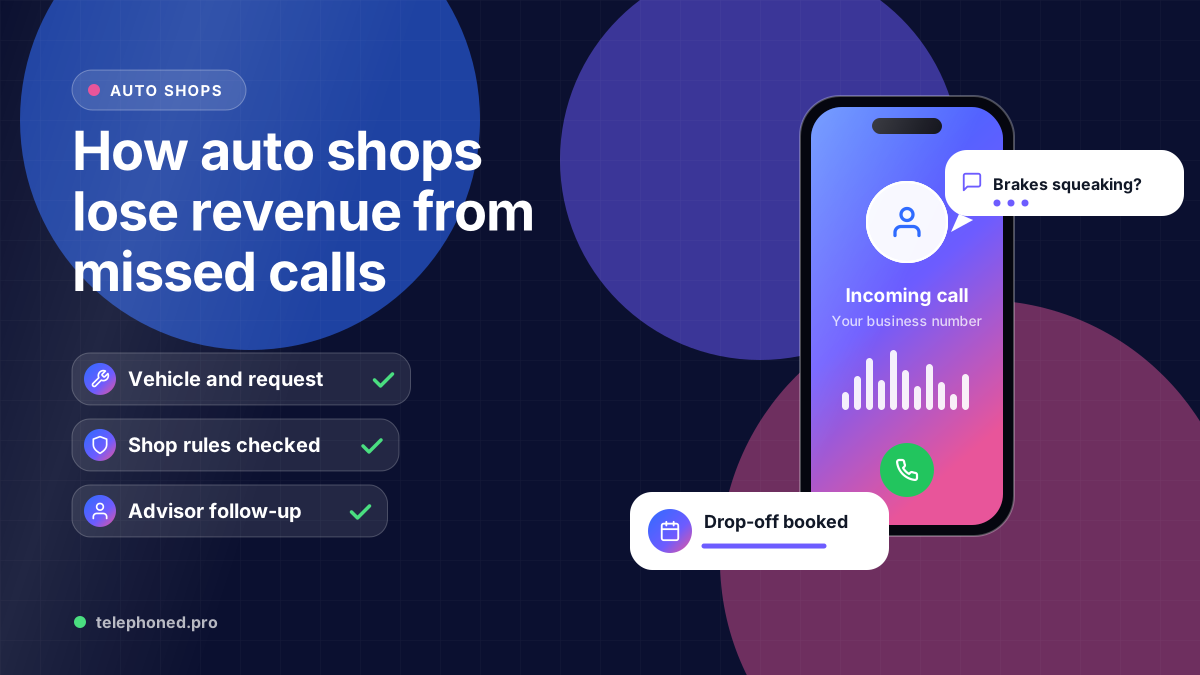
Audit repair inquiries, capture the right vehicle details and route appointment requests through shop approval, availability checks and an owned advisor handoff.
For the wider workflow, explore AI Receptionist for Business: 24/7 Answering & Booking. For a related operating question, read How Home Services Companies Lose Jobs to Missed Calls.
Prepared by the Telephoned.pro team with AI assistance and editorial review. Workflow examples are illustrative. Integration support, rollout timing and measured outcomes depend on the approved implementation.
Auto shops can lose bookable work when repair inquiries arrive while service advisors are checking in vehicles, discussing estimates or coordinating parts. The useful question is which requests go unresolved and why. An answered call does not establish that the shop can accept a vehicle, provide a reliable estimate or complete the work at the time requested.
Review a representative week of missed calls, abandoned calls and unassigned callbacks. Group repeated attempts from the same customer. Separate new repair inquiries from vehicle-status requests, parts suppliers and existing appointments. Note which branch received the request and whether another branch already responded.
Agree on the information the shop needs before promising a next step. That may include vehicle make, model and year, the customer's description of the issue, requested location and a callback number. Use the shop's approved questions and avoid representing a symptom description as a diagnosis. A service advisor should handle unclear scope, estimates that need inspection and requests outside the standard process.
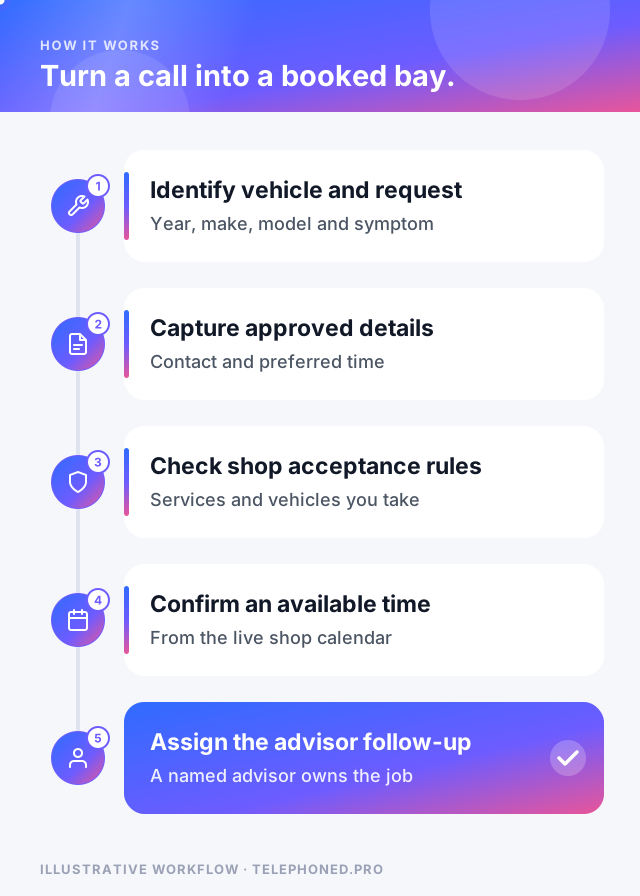
An intake workflow can create or update an inquiry record and route it to an advisor. Booking depends on supported integrations and the shop's actual scheduling rules. Check appointment type, bay capacity or inspection requirements where those are part of the process. Confirm a booking only after the scheduling system accepts it; an unavailable calendar should create an unresolved staff task.
Reminders, estimate follow-up and approved status messages can reduce repeated administration when they use a current record. Stop an estimate follow-up if the customer declines, the repair is approved or staff take over. A changed repair status should replace an outdated message rather than leave competing sequences running. Confirm communication permissions and the shop's wording before launch.
For a multi-location group, define whether each shop owns its own queue or whether a central team handles overflow. A branch label alone is insufficient: assign the person or queue responsible for the next action. Parts availability, diagnostic conclusions and final estimates remain with the shop's approved process.
Bring one real scenario to your demo. We will review the intended next step, existing systems and human handoffs.
Secure your spotAutomation is useful when it gives advisors a clear request and fewer repeated tasks. It does not guarantee a particular answer time, a fixed launch date or that every inquiry becomes work. Start with one intake path, test the exceptions and expand when the shop can verify the result.
| Call type | Example | Best next step |
|---|---|---|
| Booking request | Oil change, inspection, brake check | Offer a slot against bay and advisor availability |
| Status question | Is my car ready? | Look up the repair order or create an advisor callback |
| Estimate follow-up | Approving or questioning a quote | Route to the advisor who owns the estimate |
| Tow-in or breakdown | Car won't start in a parking lot | Escalate by your rules; capture location and vehicle |
| Parts or pricing question | Do you carry this part? | Answer from approved information or schedule a callback |
Not every call needs the same response. A status question can often be answered from the repair order, while a breakdown needs fast escalation. Mapping your most common call types to a next step is the quickest way to stop the busiest hours from turning into a backlog of callbacks.
There is no honest universal number. The useful estimate comes from your own records: count unique booking requests that went unanswered in a typical week, estimate how many would have booked, and multiply by your average repair order value for that type of job. The ROI calculator on this site walks through that calculation with your own assumptions, so you can see whether the gap justifies answering more calls.
Technicians in the trade are skilled and in short supply, so an advisor's time is better spent with customers at the counter and in the bays than returning routine calls. Automation that captures the vehicle, the concern and a callback time keeps that time free without leaving callers waiting.
For shops with more than one location, decide whether each shop answers its own calls or whether a central team handles intake for all of them. Either can work, as long as every inquiry ends up with one advisor who owns the next step and the customer knows when to expect a call back.
Keep reading
Bring one real workflow. We will show you how calls, follow-up and scheduling could connect for your business.
Keep exploring
The services and decisions that connect to this page.