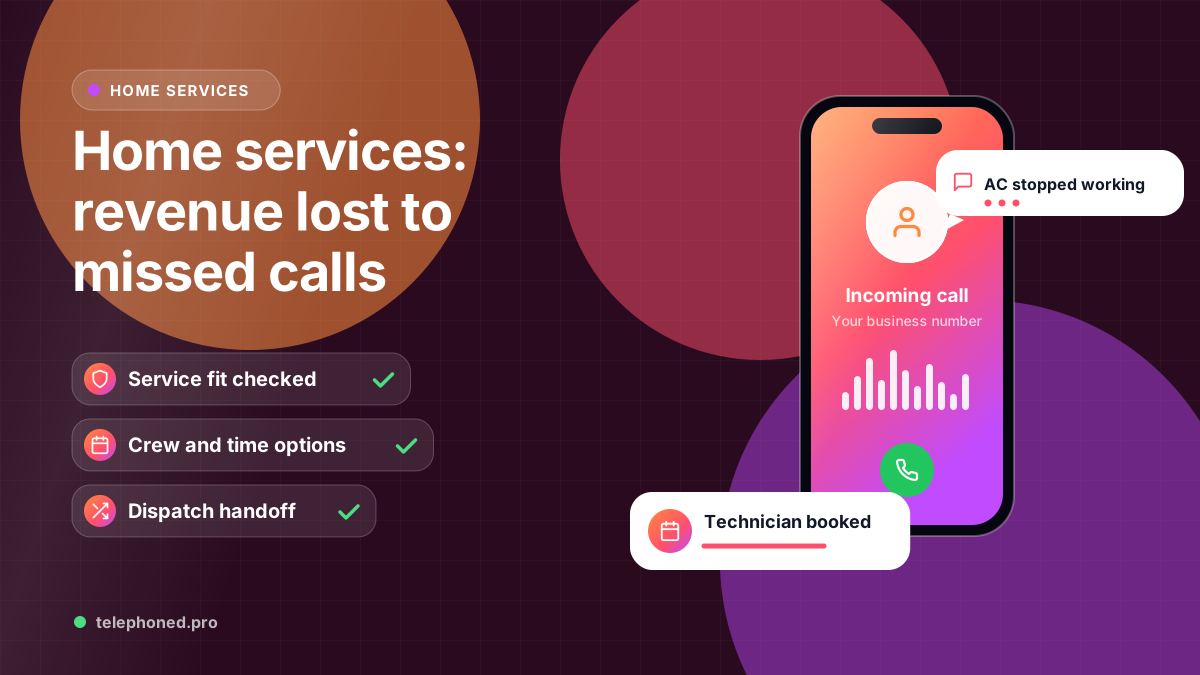
How Home Services Companies Lose Jobs to Missed Calls
Audit qualified service inquiries and connect intake with approved service rules, crew availability and dispatch ownership without promising unconfirmed jobs.
Read the guide →Home Services
An AI receptionist for plumbers should book routine jobs and wake the on-call tech for a burst pipe. See which calls to automate and which to escalate.
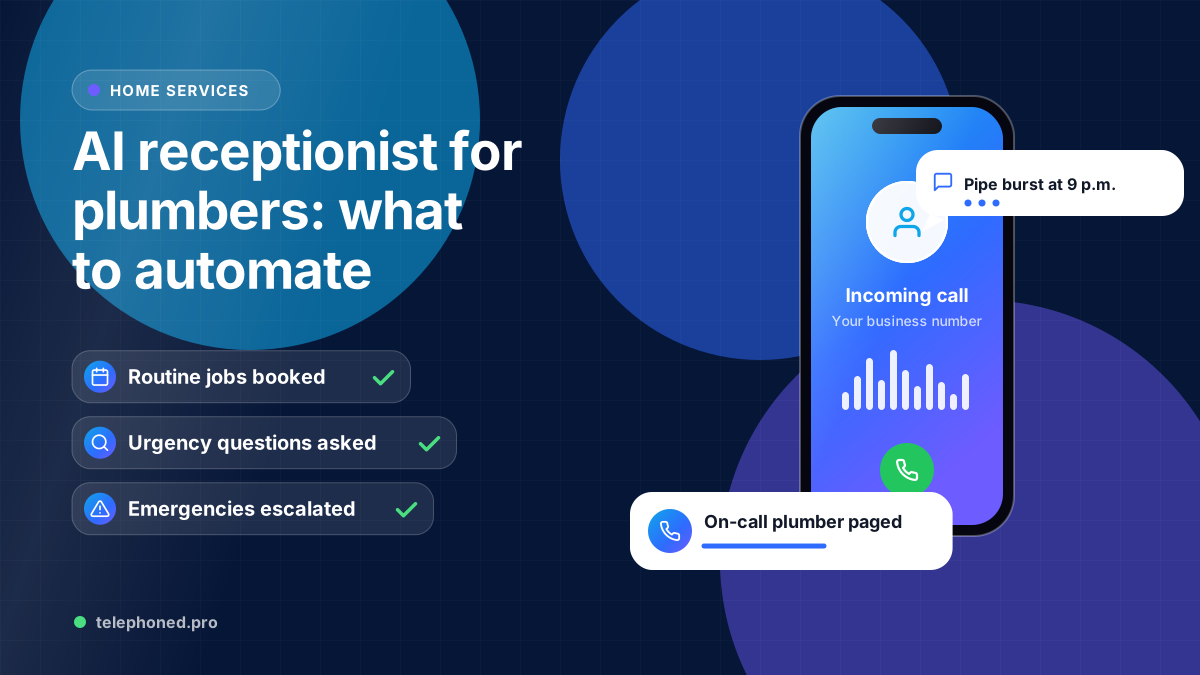
AI-assisted editorial guide from Telephoned.pro, a provider of AI receptionist services. It explains how plumbing businesses can split calls between automation and people, and cites the US EPA WaterSense program and the Bureau of Labor Statistics. Call flows are illustrative; set your own urgency rules.
An AI receptionist for plumbers should do two things well: book the routine work without anyone picking up a phone, and get a genuine emergency to the on-call plumber within minutes. Everything else, from quote questions to warranty disputes, belongs in a clear callback queue with a named owner. Get that split right and the phone stops pulling your technicians out from under sinks.
This guide shows which plumbing calls are safe to automate, which must reach a person, the questions that tell them apart, and how to roll it out without risking a missed flood at 2 a.m.
The best candidates are calls where the outcome is a booking or a piece of information you have already approved. A slow kitchen drain, a running toilet, a water heater quote or a request to move Thursday's appointment all follow the same pattern: capture the address and problem, check it against your rules, offer a slot, confirm it.
| Call type | Example | Best route |
|---|---|---|
| Routine repair | Slow drain, dripping faucet, running toilet | AI books into the next suitable slot |
| Estimate request | Water heater replacement, repipe, fixture install | AI captures details and books an estimate visit |
| Reschedule or cancel | Moving an existing appointment | AI updates the calendar under your policy |
| Active leak or burst pipe | Water coming through a ceiling at 9 p.m. | Escalate to the on-call plumber now |
| Sewage backup | Toilets backing up into a tub | Escalate to the on-call plumber now |
| Gas smell | Caller reports a gas odor near the water heater | Tell them to leave and call the gas utility or 911, then alert your team |
| Billing or warranty dispute | Unhappy with last week's invoice | Callback queue with a named owner |
Gas deserves a special rule. Your AI receptionist should not troubleshoot it. The safe script is the one your utility publishes: leave the building, do not use switches or phones inside, and call the gas company or 911 from outside. Then notify your team so someone can follow up.
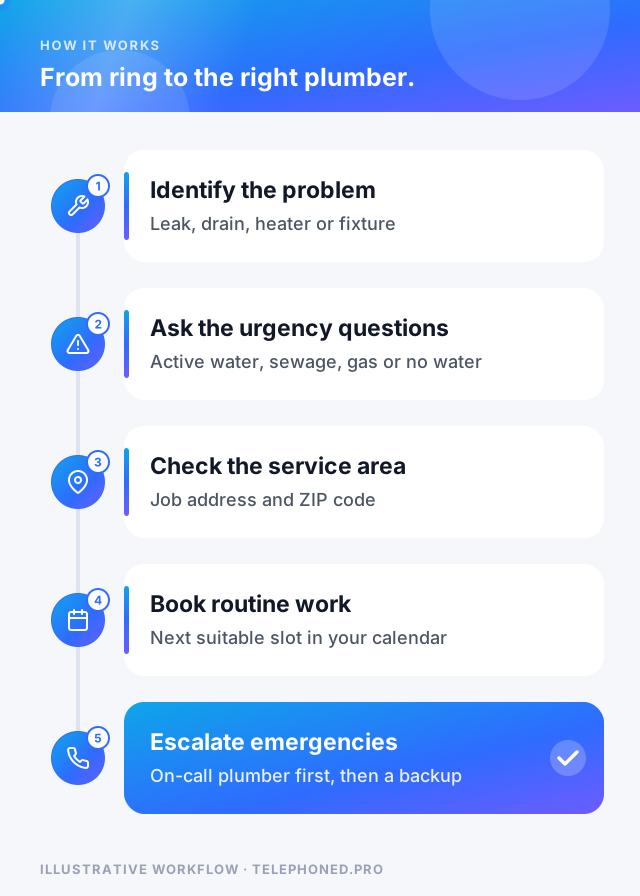
Plumbers already triage in their heads. The point is to write that triage down so the AI asks the same questions in the same order on every call, at 2 p.m. or 2 a.m.
“The AI's job on a burst-pipe call is not to fix anything. It is to tell the caller where the shut-off valve usually is, and get your on-call plumber on the phone fast.”
An emergency route needs three parts: who is on call, how they are reached, and what happens if they do not answer. A typical setup calls or texts the on-call plumber with a summary, waits a set number of minutes, then tries a backup such as the owner or a second technician. The caller is told honestly what happens next rather than promised an arrival time nobody has confirmed.
Start where the risk of change is lowest and the gain is highest: after-hours and overflow calls. During the day your office keeps answering, and the AI catches calls that would have gone to voicemail. A water heater shop in Dallas or a two-van outfit in Columbus can usually see in a single week which calls the AI handles well and which rules need tightening.
| Week | What the AI handles | What you check |
|---|---|---|
| 1 | After-hours and missed daytime calls | Every emergency escalation and every booking it made |
| 2 | Plus estimate requests and rescheduling | Whether estimate details are complete for the tech |
| 3+ | Daytime overflow when the office is busy | Weekly sample of calls and any caller complaints |
If you want a number before you start, count last month's missed and after-hours calls, estimate how many were real jobs, and multiply by your average ticket. Our ROI calculator does that arithmetic with your own figures.
Keep reading
Bring one real workflow. We will show you how calls, follow-up and scheduling could connect for your business.