US business call workflows
AI receptionist for plumbers
with a clear next action.
An AI receptionist for plumbers answers service calls, captures the address and job details, checks your approved service rules and routes the next action to scheduling or your on-call team. Telephoned.pro scopes that intake around your existing business number and workflow. A captured plumbing request is never presented as a dispatched technician unless your process actually confirms it.
Review AI Receptionist for Home Services: Never Miss a Job Call. A related guide to check alongside this page is AI Receptionist for Plumbers: What to Automate.
Workflow review
A burst-pipe call needs a different path from an estimate
Illustrative scenario: a homeowner calls after dinner because water is spreading beneath a kitchen cabinet. Your receptionist needs the business-approved urgent-call instructions, an accurate callback number and the service address. It should establish the reason for the call without diagnosing the plumbing problem or promising that a technician is already on the way. If the caller reports an immediate safety hazard, follow the emergency wording your business has approved.
Compare that with a request to replace a bathroom faucet next week. The routine inquiry can follow your service-area, job-type and calendar rules. The urgent inquiry needs the appropriate human escalation. Treating both as the same appointment request creates avoidable confusion. Your intake design should make the difference explicit before any scheduling action is attempted.
Workflow review
A plumbing call flow to review in the demo
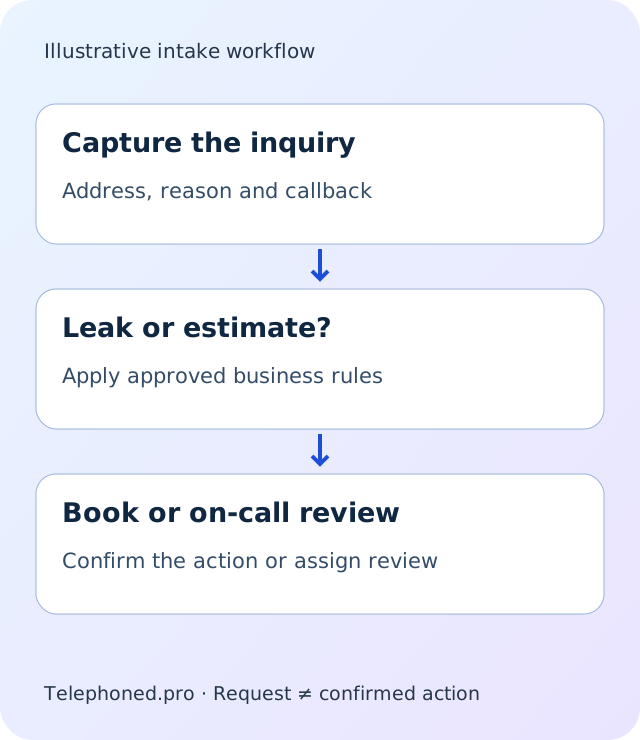
Start with a greeting that identifies the business and makes the assistant's role clear. Capture the caller's name, callback number, service address and a plain-language description of the request. Ask the questions your team actually uses to classify the work, such as whether it concerns a leak, drain, fixture, water heater or planned installation. Do not ask for unnecessary personal details just because a form has space for them.
Check the location against your service-area rules before discussing availability. Then distinguish a new service request from a callback about an existing job, a warranty question or an invoice issue. Existing work should reach the responsible office or technician with context. A new estimate should follow the approved booking route. An uncertain address, unsupported job type or unclear urgency belongs in a review queue with a named owner.
Before telling the caller that a visit is booked, verify the calendar or dispatch action actually completed. If it did not, describe the result as a request awaiting confirmation. Your staff should receive the reason, location, contact details and promised next step together. The caller should not need to repeat the entire story when someone takes over.
Your call flow
Review a normal request and an exception
Bring your current tools and operating rules. We will distinguish confirmed actions from requests that need your team.
Workflow review
Set limits on urgent routing and arrival promises
Your business decides which situations reach the on-call person and which wait for office hours. The assistant follows those instructions; it does not make independent technical judgments about gas, electricity, structural damage or the safety of a property. Ask a technical review to show the exact language used when a caller describes danger or asks for advice beyond the approved script.
A transfer can ring without being accepted. Define the fallback before launch: another approved contact, a message with callback ownership or a clear explanation of the next step. Never turn an unanswered transfer into a claim that help has been dispatched. If arrival windows require a dispatcher to review the route, keep that approval with the dispatcher. The same rule applies when weather or an unusually busy evening changes capacity.
Review this workflow with your team.
Bring one routine request and one exception. Review existing-number forwarding where supported, plus AI transparency.
Workflow review
What to check before choosing a plumbing answering setup
Bring your current number, forwarding options, service map, staffed hours and on-call rotation to discovery. Include your actual calendar or field-service tool as a requirement to validate. A product logo is not proof that the required account actions are supported. Ask which records can be read or written, how permissions are granted and what happens if that connection is unavailable.
Test a routine estimate, an urgent request, a caller outside your area and a customer checking an existing job. Add a noisy connection, an interrupted answer and a caller who changes the address. Review the resulting records as carefully as the voice. An attractive conversation is not enough if the service address is wrong or no one owns the follow-up.
Decide how duplicate calls are handled. A customer who calls again about the same leak should not automatically create another appointment or trigger another follow-up sequence. Keep the active request and its owner visible. Review retention and access requirements before connecting customer records, and use fictional information during the initial demonstration.
Workflow review
Start with the handoff that needs attention
You can evaluate overflow or after-hours intake while your staff continues answering the calls they already handle well. Identify one inquiry type and agree the evidence needed to show it reached the next action. A useful pilot distinguishes captured requests, qualified jobs, confirmed appointments and unresolved callbacks. It does not count every conversation as new revenue.
The informational plumbing guide explains what kinds of calls are sensible to automate. This service page helps you assess the proposed intake and handoff for your own business. Bring one ordinary job and one exception to the demo. We can discuss how phone coverage fits into follow-up and customer-record workflows while keeping technical decisions and service commitments with your team.
Ask who updates the instructions when your service area, office hours or on-call rotation changes. A workflow needs an accountable maintainer and a repeatable review after changes, not just a successful first test.
Before you decide
Questions about the proposed setup
It can follow your approved escalation workflow. A technician is only described as dispatched when your actual process confirms that action; unanswered transfers need a fallback owner.
The proposed setup uses call forwarding where your phone provider supports it. Check your provider and forwarding rules before launch.
Bring the exact tool and required actions to discovery. Supported connections, permissions and failure behavior must be verified before implementation.
Want to hear it on your own calls?
Secure your spotReview the workflow
around your business.
Bring a typical call and one exception. We will explore the right scope, dependencies and staff handoffs before you decide.