US business call workflows
AI receptionist for towing companies
with a clear next action.
An AI receptionist for towing companies captures the caller’s location and vehicle request, distinguishes a new assistance inquiry from an existing tow and routes the next step to your dispatcher. Telephoned.pro scopes intake around your operating rules and available systems. The assistant does not promise a truck, establish roadside safety or authorize a release; dispatch and verification remain with your team.
Review AI Receptionist for Home Services: Never Miss a Job Call. A related guide to check alongside this page is AI Receptionist for Cleaning Services.
Workflow review
A roadside inquiry needs accurate location and ownership
Illustrative scenario: a driver calls after the office has become busy and asks for a tow from a parking lot. The first conversation should capture a reliable callback number, the stated location and the general request, then follow the dispatcher-approved path. A vague location needs clarification or human review. It should not become a confident arrival promise.
A new tow request differs from someone checking the status of an active job or asking about a stored vehicle. Your business may also distinguish roadside services, commercial requests and work it cannot accept. Establish those categories before launch. The assistant should explain only approved next steps and avoid making assumptions about eligibility, authority or available equipment.
Workflow review
Design the towing intake before connecting dispatch
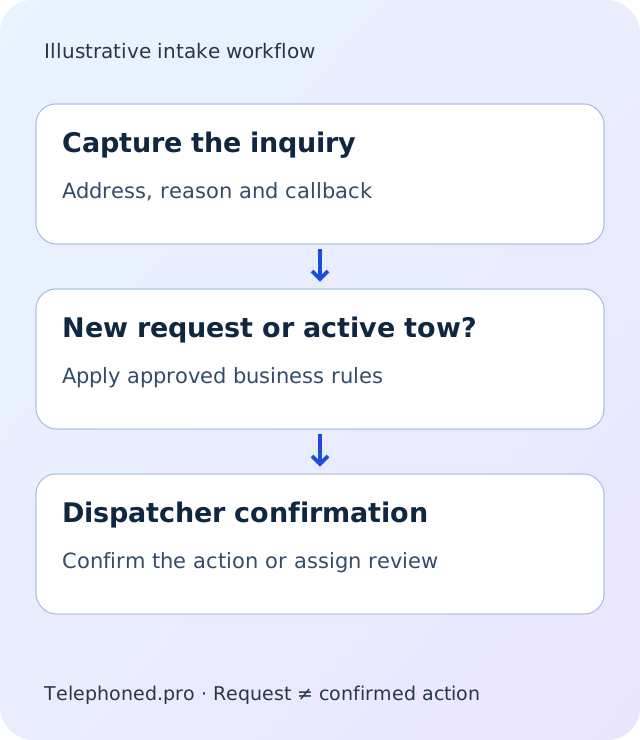
Start by identifying whether the call concerns a new request, an existing job or a vehicle-release inquiry. Capture the caller's name, callback number and the details your dispatcher requires for that category. For a new request, that may include the reported pickup location, intended destination and approved vehicle information. Do not collect unnecessary sensitive documentation during ordinary phone intake.
Check the service area and the categories your company handles. A request requiring specialized equipment or an uncertain pickup situation should reach the dispatcher rather than be accepted automatically. The assistant can record what the caller reports, but it should not determine whether the vehicle can be moved safely or whether the caller has legal authority to move it.
Route the request to the appropriate person or verified dispatch action. Keep a captured inquiry, an accepted job and an assigned truck distinct. If the dispatcher or destination system has not confirmed the action, tell the caller that the request is awaiting confirmation. Record the location and the exact commitment made so the next person can continue without reconstructing the conversation.
Your call flow
Review a normal request and an exception
Bring your current tools and operating rules. We will distinguish confirmed actions from requests that need your team.
Workflow review
Use approved emergency and unavailable-dispatch paths
A caller may be distressed, describe a dangerous roadside situation or report an injury. Your team must supply the approved wording and escalation procedure. The assistant should not provide improvised safety or recovery instructions or substitute itself for emergency services. A demonstration should show how those boundaries hold when a caller interrupts or asks for advice outside scope.
Define what happens if the dispatcher cannot accept the call. A backup contact, supervised queue or owned callback process may fit your operation. Do not imply a truck is traveling simply because the transfer rang. Arrival estimates depend on your dispatch process and current conditions. If those cannot be verified, the assistant should say that confirmation is needed instead of inventing a number.
Review this workflow with your team.
Bring one routine request and one exception. Review existing-number forwarding where supported, plus AI transparency.
Workflow review
What to check before choosing towing call automation
Bring your operating area, accepted services, dispatch contacts and existing-job process. Explain which requests require a dispatcher and which administrative questions have approved answers. Vehicle-release inquiries may need a separate verification and documentation procedure. A general answering workflow should not disclose private information or bypass that process.
Test a new request with a clear location, a caller who cannot describe the location precisely, an active-job status inquiry and a request outside your area. Add an unavailable dispatcher and a destination-system failure. Inspect whether the resulting record distinguishes the caller's report from a confirmed dispatch fact. Check callback accuracy and the owner assigned to unresolved work.
Verify the exact account actions in any dispatch or customer-management connection. Ask whether the workflow captures a lead, creates a pending request or actually assigns work, and who authorizes each action. A tool name does not establish operational compatibility. Use fictional vehicles and locations for discovery rather than private release documents or customer records.
Workflow review
Evaluate the result as a dispatch handoff
The useful measure is whether an inquiry reaches an accountable next action with accurate details. A conversation, accepted job, dispatched truck and completed tow are separate events. Your own records should define them. Do not use answered-call totals as a substitute for completed service outcomes or assume that every caller represents new business.
Repeated calls about the same active job should retain the existing owner and context. They should not automatically create another tow request or launch another follow-up sequence. A cancellation or dispatcher update needs to affect subsequent communication. These stop and reconciliation rules belong in the design alongside the initial greeting.
Start with one narrow call category and review the normal and difficult cases together. Overflow intake can be assessed without replacing the dispatcher who already manages your trucks. Bring an ordinary inquiry and an exception to the demo. The proposed workflow should keep equipment, authority, safety and arrival commitments with the appropriate people while making routine intake easier to review.
Before you decide
Questions about the proposed setup
Only a verified dispatch process can establish an arrival commitment. Without confirmation, the assistant should capture and route the request honestly.
Ordinary intake does not establish authority or complete release requirements. Follow your separate staff-controlled verification procedure.
Use the business-approved emergency wording and escalation process. The assistant should not improvise roadside safety instructions.
Want to hear it on your own calls?
Secure your spotReview the workflow
around your business.
Bring a typical call and one exception. We will explore the right scope, dependencies and staff handoffs before you decide.