US business call workflows
AI receptionist for landscaping companies
with a clear next action.
An AI receptionist for landscaping companies captures new estimate requests, identifies existing maintenance customers and routes scheduling questions to the right person. Telephoned.pro scopes phone intake around your service area, crew responsibilities and current tools. A requested landscaping visit is only confirmed when your actual scheduling process accepts it; design advice, site assessments and changes to contracted work stay with your team.
Review AI Receptionist for Home Services: Never Miss a Job Call. A related guide to check alongside this page is AI Receptionist for Cleaning Services.
Workflow review
Separate a new project from a recurring-service request
Illustrative scenario: a homeowner calls while your crew is finishing a property and asks about a backyard redesign. Another caller wants to know whether rain will change an existing maintenance visit. Those inquiries need different records and different owners. The first may become a consultation or estimate request; the second belongs with the team managing an active service relationship.
Start by identifying why the person is calling, not by trying to fill every calendar gap. Your crew may handle lawn maintenance, landscape installations, irrigation or only selected services. The assistant should use the categories and exclusions you approve. It should not invent availability for a service you do not perform or describe a design recommendation as if a qualified team member had assessed the property.
Workflow review
A landscaping call flow that respects crew capacity
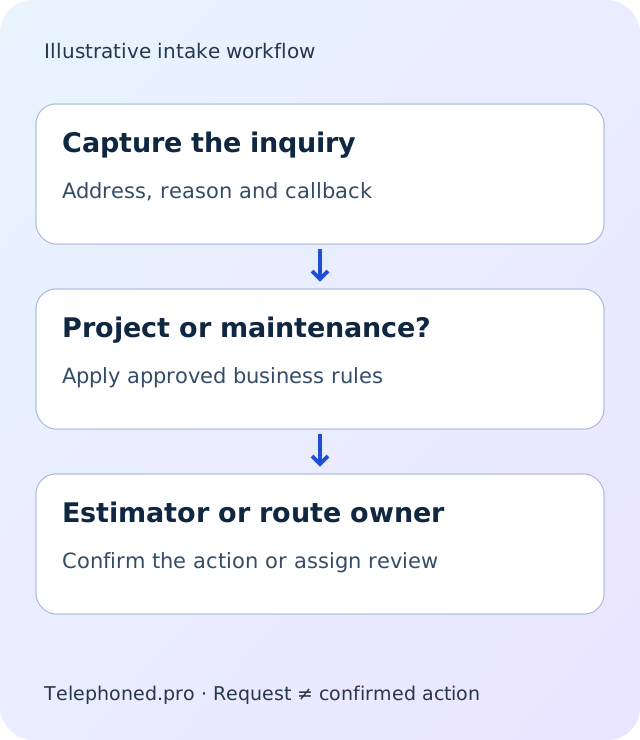
Capture the caller's name, callback preference, property address and requested work. Ask whether it is a new project or an existing account, then use your approved questions to establish the next step. A simple service inquiry may need a different appointment type from a design consultation or a larger installation estimate. Do not promise a final scope from a short phone description.
Check the service area before discussing an appointment. For recurring maintenance, identify the existing route or account owner where the information can be verified. A customer asking to add work to a scheduled visit may need approval rather than an automatic calendar change. The intake should preserve the request and its context while leaving crew assignments with the authorized person.
Offer only appointment actions supported by your actual schedule. A consultation can be requested without implying that installation work is scheduled. Where weather, site access or an estimator's review affects availability, explain that confirmation is pending. The resulting record should distinguish the requested service, any existing commitment and the exact next action the caller was told to expect.
Your call flow
Review a normal request and an exception
Bring your current tools and operating rules. We will distinguish confirmed actions from requests that need your team.
Workflow review
Keep weather changes and property risks reviewable
Weather can change a landscaping schedule without changing the customer's original request. Define who updates the operating instructions and who handles affected visits. The assistant should not independently decide that a crew can travel, that a property is safe or that a service will happen despite conditions. Use your approved language and route uncertain situations to staff.
Some callers may describe a broken irrigation line, a fallen tree or damage to a property. Your team decides which issues are in scope and which require an urgent human handoff. An unanswered transfer needs a clear fallback owner. Do not substitute an unsupported arrival promise for that handoff, and do not give technical or safety instructions beyond the wording approved for the workflow.
Review this workflow with your team.
Bring one routine request and one exception. Review existing-number forwarding where supported, plus AI transparency.
Workflow review
What to check before choosing landscaping phone automation
Bring your service map, service categories, recurring-account process and estimate calendar. Explain which questions help your office distinguish routine maintenance from project work. If crews serve different neighborhoods or service types, identify the assignment rules. A calendar connection alone cannot determine whether a crew, vehicle or specialist is suitable for a job.
Ask the demo to handle a new installation estimate, a maintenance customer asking about a current visit, an out-of-area inquiry and a caller requesting a service you exclude. Add an unavailable calendar and an unanswered staff transfer. Review both the conversation and the saved record. Check that a requested change has not silently overwritten an existing commitment.
If you use a CRM, scheduling platform or field-service system, bring the exact product and desired actions for validation. Confirm supported reads and writes, access requirements and failure handling before implementation. A tool name in a proposal does not establish that every account workflow is available. Use fictional properties during discovery rather than sharing private customer records.
Workflow review
Connect estimate intake with practical follow-up
An estimate request should have a responsible owner and a status your team understands. If the caller already has a proposal, the next action may be a question for the estimator rather than another introductory sequence. A reply, accepted proposal or declined project should affect subsequent follow-up. Repeated contact without current context can make an otherwise useful workflow frustrating.
Evaluate one defined call type first. Overflow coverage while crews are working may be enough to test intake quality and ownership. Review captured requests, confirmed consultations and unresolved exceptions separately. Use actual completed outcomes from your records when assessing value; neither a long conversation nor a full inquiry form proves that additional work was won.
Bring a routine request and a difficult exception to the demo. The purpose is to examine how the phone handoff fits into your existing operating process, including who changes instructions and who reviews failures. Your team keeps control over design, estimating and crew commitments while routine information moves through an agreed path.
Before you decide
Questions about the proposed setup
An estimate appointment can follow approved service and calendar rules where the required connection is verified. A consultation request must stay distinct from confirmed project work.
Route and crew changes should remain with the authorized team unless an exact approved action has been scoped and validated. The assistant can capture and route the request.
Use current business-approved instructions and a staff owner. The assistant should not make independent decisions about conditions or crew safety.
Want to hear it on your own calls?
Secure your spotReview the workflow
around your business.
Bring a typical call and one exception. We will explore the right scope, dependencies and staff handoffs before you decide.