US business call workflows
AI receptionist for locksmiths
with a clear next action.
An AI receptionist for locksmiths captures the lock or access request, checks the service location and routes it through your approved dispatch process. Telephoned.pro scopes answering and follow-up around your existing number and operating rules. Intake does not authorize entry, establish ownership or confirm that a technician is dispatched; those decisions stay with your qualified team and verified process.
Review AI Receptionist for Home Services: Never Miss a Job Call. A related guide to check alongside this page is AI Receptionist for Cleaning Services.
Workflow review
A lockout call needs clear boundaries from the start
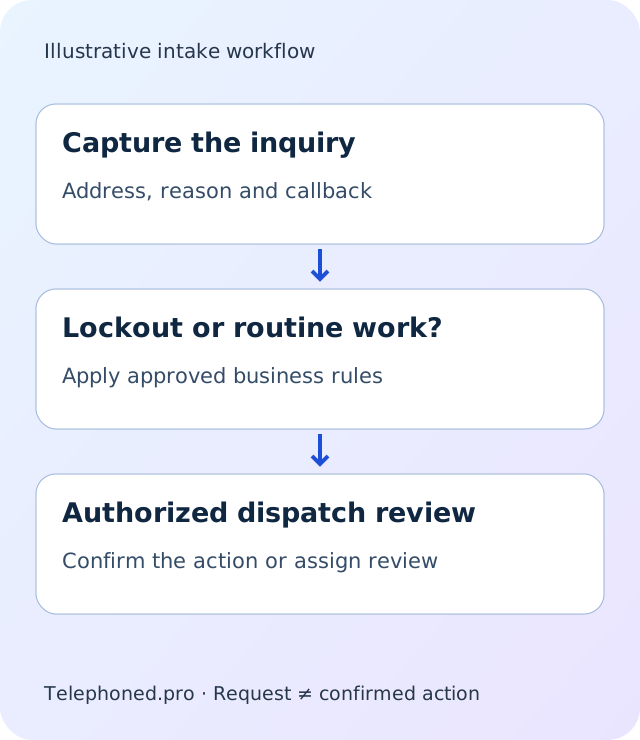
Illustrative scenario: someone calls late in the evening because they cannot enter a property. The assistant can capture the location, callback number and general request, then follow your urgent-routing instructions. It should not provide bypass instructions, assure the caller that entry will be permitted or state that a technician is already traveling when no dispatch confirmation exists.
A routine rekey estimate, an automotive key inquiry and a commercial access issue may require different staff or equipment. Your business defines which work it accepts and what must be verified before service. An assistant should identify the requested category and route uncertainty to staff rather than attempt to resolve authorization or technical suitability on its own.
Workflow review
A locksmith call flow to examine before launch
Begin with the caller's name, safe callback preference, service address and a brief description of the request. Establish whether the inquiry concerns a home, vehicle or commercial property using your approved categories. Ask the minimum operational questions your team needs to determine the next step. Do not collect copies of identity documents through a general phone-intake process.
Check the service area and hours before discussing availability. Explain any staff-review requirements using approved wording. A caller's description of their relationship to a property can be captured as information, but it is not proof of authority to enter. Your technicians or authorized staff retain responsibility for the required verification before work proceeds.
Route an urgent request to the correct dispatcher or on-call person. For routine work, offer only the approved appointment or callback path. Where a technical match, vehicle information or commercial access requirement needs review, make that dependency clear. The saved request should include what the caller said and the action promised, without converting an unverified statement into an established fact.
Your call flow
Review a normal request and an exception
Bring your current tools and operating rules. We will distinguish confirmed actions from requests that need your team.
Workflow review
Treat dispatch and arrival as confirmed events
A ringing transfer is not an accepted job. Agree what happens if the dispatcher cannot answer: another approved contact, a message with ownership or a truthful callback explanation. Do not invent a technician's location, estimated arrival or availability. If the business requires a dispatcher to approve the work, the assistant should keep that approval step visible.
Some callers may describe immediate danger or someone at risk. Your business needs approved emergency language and routing for those situations. The assistant should not substitute itself for emergency services or give technical entry instructions. Ask the demonstration to show the exact response and fallback. These boundaries matter as much as the greeting or the speed of intake.
Review this workflow with your team.
Bring one routine request and one exception. Review existing-number forwarding where supported, plus AI transparency.
Workflow review
What to check before choosing locksmith call automation
Bring the services you accept, areas covered, staffed hours and dispatch contacts. Identify which categories need a specialist and which require additional verification. Decide who maintains the instructions when on-call coverage changes. A stale routing number can leave an urgent request without an owner even if the initial conversation sounds competent.
Test a residential lockout, a routine rekey request, an automotive inquiry and a commercial customer calling about an existing job. Add an out-of-area address, an unclear authorization claim and an unavailable dispatcher. Review whether the assistant respected the limits, captured an accurate callback number and described the next step honestly. No test should require real identity documents or private access credentials.
If a dispatch or customer-management tool is involved, verify the exact supported account actions. Ask how duplicate requests are recognized, whether a job can be created without authorization and how failed writes are handled. A connection should reflect your approval process rather than create a shortcut around it. Confirm what staff can review and correct after a call.
Workflow review
Measure the handoff without treating every call as a job
A locksmith inquiry can end as an accepted dispatch, a scheduled routine visit, a review request or work your business declines. Keep those outcomes separate. Do not count a captured call as a completed service. Where the caller contacts the business repeatedly about the same situation, preserve the active request and its owner instead of creating multiple independent dispatches.
Begin with the narrowest useful scope, such as overflow intake that routes to your existing dispatcher. Review normal requests and difficult exceptions with the responsible staff. The decision to expand should depend on actual records and whether the workflow follows your operating rules. There is no need to replace an effective dispatch team to evaluate a clearer intake handoff.
Bring one routine inquiry and one urgent scenario to the demo. We can discuss how the phone conversation connects with approved records and follow-up while your people retain authority over access, technical work and service commitments. The proposed setup should make that division of responsibility explicit before it is used with real callers.
Before you decide
Questions about the proposed setup
No ownership or access authorization is established by ordinary intake. Your authorized staff and technicians must follow the business verification process before service.
It can route an urgent request through approved dispatch rules. Dispatch and arrival claims require an actual confirmed action, with a fallback when staff are unavailable.
The proposed intake should not provide bypass instructions. It captures the service request and routes it to the appropriate qualified team.
Want to hear it on your own calls?
Secure your spotReview the workflow
around your business.
Bring a typical call and one exception. We will explore the right scope, dependencies and staff handoffs before you decide.