AI Receptionist Service-Area Qualification Before Booking
Build a service-area qualification workflow that checks location before an AI receptionist offers an appointment, while routing uncertain and out-of-area inquiries correctly.
Read the guide →Beauty Salons
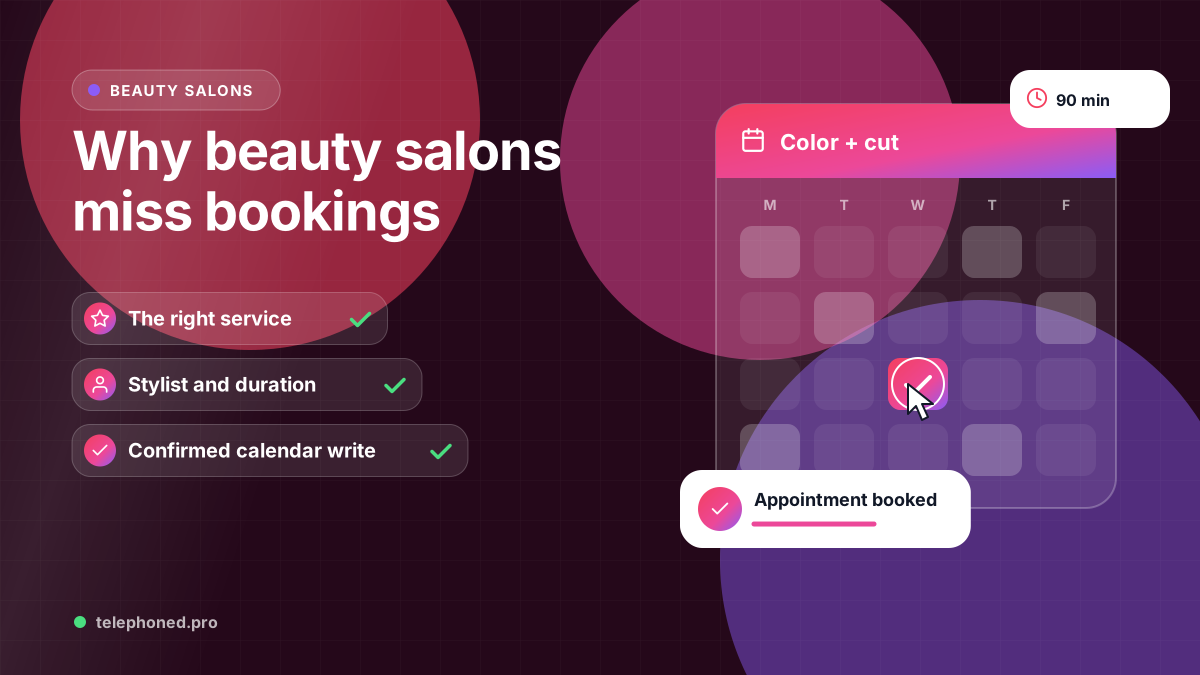
Build a salon inquiry workflow that checks service duration, stylist requirements and calendar confirmation while staff stay available for exceptions.
For the wider workflow, explore AI Receptionist for Salons. For a related operating question, read AI Automation for Salons and Beauty.
Prepared by the Telephoned.pro team with AI assistance and editorial review. Workflow examples are illustrative. Integration support, rollout timing and measured outcomes depend on the approved implementation.
A salon can have a busy floor and unresolved booking inquiries at the same time. Calls may arrive while the front desk checks out a client, handles a walk-in or discusses a service. The solution is a reliable path from inquiry to an approved booking or a staff-owned follow-up, rather than assuming every call can be scheduled automatically.
Review calls, messages and online inquiries together. A customer may contact the salon more than once, so group those attempts into one request. Separate new booking inquiries from existing appointments, supplier calls and questions that staff already answered. Compare operating hours, evening inquiries and branch queues to locate the gap.
Do not assume a missed call is a lost appointment or multiply all calls by an average service value. Count qualified requests the salon could serve, then use explicit assumptions about recovery and booking conversion. Keep that estimate separate from appointments that were actually confirmed and services that were completed.
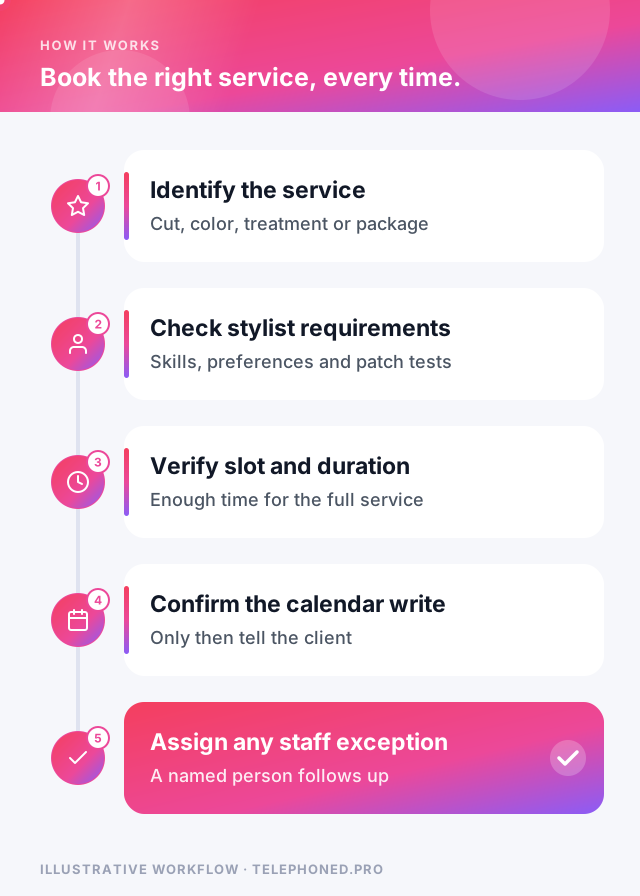
Some requests need a conversation with a stylist before a time can be offered. Examples may include a complex color change, an unclear service choice or a correction to previous work. Use the salon's approved criteria; a workflow should not turn every request into a standard service just because a slot appears open.
Booking automation depends on the supported calendar integration and the salon's maintained rules. Offer only valid options and confirm the appointment after the calendar accepts the write. A failed write or uncertain availability should lead to a staff task, not a success message. A reschedule should preserve the existing appointment until the intended change is confirmed.
Connect reminders and approved follow-up to the current booking status. A cancellation, completed service or client request to stop should update the workflow before another message is sent. Review permissions and wording with the team. Reminder delivery is a process result; fewer no-shows or more rebookings must be measured using the salon's records.
Bring one real scenario to your demo. We will review the intended next step, existing systems and human handoffs.
Book a free demoFor a salon group, decide whether a central desk or the local branch owns unresolved inquiries. The record should show the requested service, what was already communicated, the next action and an accepted owner. Staff can then continue the conversation without asking the client to start again.
| Request | Book automatically? | Why |
|---|---|---|
| Standard cut or blow-dry | Usually yes | Fixed duration and known price |
| Color correction | Usually no | Needs a consultation first |
| Returning client with a preferred stylist | Yes, if the calendar is connected | Availability is clear |
| Group or event booking | Usually no | Several stylists and timing to coordinate |
| Reschedule or cancellation | Yes, under your policy | Follows your notice and deposit rules |
A useful rule: if a booking can go wrong only by being in the wrong slot, it can usually be automated; if it can go wrong by being the wrong service, a stylist should see it first.
Reminders work best when they are timely, easy to act on and stop as soon as the client confirms or reschedules. Send a confirmation at booking, one reminder before the appointment, and a simple way to reschedule that checks real availability. Texts need the client's consent, and opt-out requests such as STOP must be honored; industry messaging guidelines and FCC rules both expect that.
Licensed stylists are the salon's main capacity: every state requires barbers, hairstylists and cosmetologists to be licensed, according to the Bureau of Labor Statistics. Protecting their chair time from no-shows and phone interruptions is one of the most direct ways to protect revenue.
Finally, review the requests that could not be booked automatically each week. They show which services need clearer booking rules, which stylists are most in demand and where the calendar needs more flexibility, which is useful information for planning the floor as well as the phones.
Keep reading
Bring one real workflow. We will show you how calls, follow-up and scheduling could connect for your business.
Keep exploring
Guides picked for this page, plus the services and decisions that connect to it.
An AI receptionist for salons captures appointment inquiries, checks approved service and provider rules and routes requests to booking or your front desk.