English and Spanish for US business calls
Bilingual AI receptionist
for English–Spanish calls.
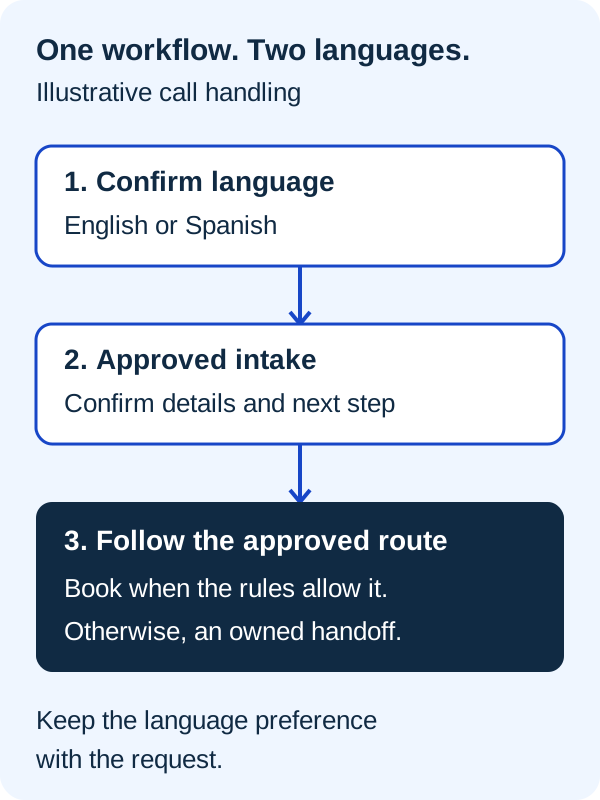
Telephoned.pro supports English–Spanish AI call answering. A useful bilingual receptionist does more than translate a greeting: it follows your approved intake questions, preserves the caller's language preference and moves the inquiry toward the right booking or human handoff. We review that complete workflow against your business, phone setup and staff responsibilities.Start with the conversations you actually receive. Test routine requests, a language switch and the point where a person needs to take over.
Review AI Receptionist for Business: 24/7 Answering & Booking. A related guide to check alongside this page is AI Receptionist Call Transfer.
Start with the caller
Design one service process in two languages
A business can offer the same service while callers explain their needs differently. Your English and Spanish scripts should ask for the same essential facts without forcing a word-for-word translation that sounds unnatural. Define the service categories, approved answers and escalation boundaries first. Then review how those instructions sound in each language, including the vocabulary customers use for the work you do.
The goal is a consistent outcome. A caller asking about an available service should receive an accurate answer in the chosen language. A caller requesting an appointment should follow the same eligibility and scheduling rules. A caller needing human judgment should reach an owned handoff rather than receive a guessed answer. The AI receptionist overview explains the broader service; the call transfer guide covers acceptance and fallback decisions.
An illustrative US scenario
Follow an HVAC inquiry from greeting to next action
Imagine a homeowner calling an HVAC company about a cooling problem. This is an illustrative example, not a customer result. The greeting offers English or Spanish, or confirms a language preference within the approved call design. The assistant gathers the service address, callback number and reason for the inquiry. It does not infer a diagnosis or promise that a technician will arrive at a particular time.
The caller may describe the equipment using informal terms, spell an address or ask for the question to be repeated. Review how those moments are handled in both languages. Names, addresses and phone numbers need confirmation because a fluent conversation is not enough if the contact details are wrong. If the caller changes languages, the workflow should retain the information already captured and confirm the preferred language for the next step.
A routine request can move toward an appointment when the agreed scheduling setup supports it. An urgent or out-of-scope inquiry follows the business's escalation instructions. If the receiving staff member speaks only English, define the explanation and handoff process in advance. Do not assume a bilingual front door makes every downstream team or connected tool bilingual.
Hear the complete conversation
Bring a real call scenario in each language
Use fictional customer details to review the greeting, intake questions and human handoff. We will confirm the scope and dependencies before implementation.
Scope before rollout
Choose how language selection should work
Decide whether the greeting should explicitly offer a choice, confirm a preference after the caller speaks or use another agreed approach. Keep the instruction short enough that callers understand what to do. Test someone who pauses, gives a brief answer or asks for a person immediately. The choice should help the conversation begin rather than create another confusing menu.
List the languages actually supported in the proposed setup. English–Spanish support does not establish support for every language, regional expression or specialized professional term. Supply the names of your services and any words that must be said consistently. Where accurate interpretation requires professional expertise, route the question to the appropriate person rather than treating conversational language support as a qualified interpreting service.
Review this workflow with your team.
Bring one routine request and one exception. Review existing-number forwarding where supported, plus AI transparency.
Connected follow-through
Carry the language preference beyond the call
A useful intake record includes the customer's preferred language and enough context for staff to continue. Agree how that information will appear in the authorized destination, who can access it and who owns the response. Confirm the specific CRM, calendar or other connection during scoping. Language support alone is not a promise of compatibility with every business system.
Review confirmation messages and subsequent follow-up separately. A Spanish-language phone conversation should not automatically trigger an unreviewed sequence in another language. Confirm which message templates are available, which channels are in scope and how replies or opt-outs change the workflow. Keep the appointment record authoritative so a later message does not contradict what was booked.
If a human transfer is unavailable, the fallback must remain understandable in the caller's language. That might be an accurately described callback request or another approved destination. Define who receives the request and what counts as completion. The assistant should not invent a bilingual staff member, an immediate response or a service commitment when the assigned person is unavailable.
Acceptance testing
Review meaning, accuracy and exceptions
Test more than a polished greeting. Include a new inquiry, an existing customer's question, an address correction, background noise and a request outside your service area. Ask a fluent reviewer to assess whether the intended meaning is preserved. Check the saved details and next action after each test, because the conversation and the operational record both need to be right.
Add a language switch and an interruption. Confirm that the caller can correct a name or number without losing the earlier context. Review what happens when the assistant does not understand a phrase. A clear clarification or human handoff is preferable to a confident guess. Use the same decision boundaries in both language versions, especially around technical advice, sensitive information and urgent situations.
Select a narrow initial workflow, such as routine new-customer intake. Document the approved script, supported next steps and responsible staff. After launch, use actual call review to decide what needs adjustment. Do not treat bilingual availability as proof of more bookings, improved satisfaction or a revenue increase; those outcomes require evidence from your own business.
Before you decide
English–Spanish answering questions
Yes. English–Spanish call answering is supported. Confirm the greeting, service vocabulary, intake rules and handoff requirements for your specific business during scoping.
Include language switching in your demo and acceptance tests. Agree the expected behavior, how captured details are retained and when a person should take over before rollout.
No such claim is made. Conversational call answering should not be treated as a qualified interpreting service for legal, clinical or other specialist decisions. Route those requests to an appropriate professional.
Those are separate implementation requirements. Confirm the exact system connection, language fields and approved message templates. Do not assume every downstream tool or team supports both languages.
Bring representative questions in English and Spanish, your scheduling and routing rules, and one difficult exception. Use fictional customer details and avoid sharing sensitive records or account credentials.
One customer workflow,
reviewed in both languages.
Bring the calls your team receives and the systems you already use. We will review English–Spanish intake, the approved next step and the handoff to your staff.