How to Pair an AI Receptionist with Your Front Desk
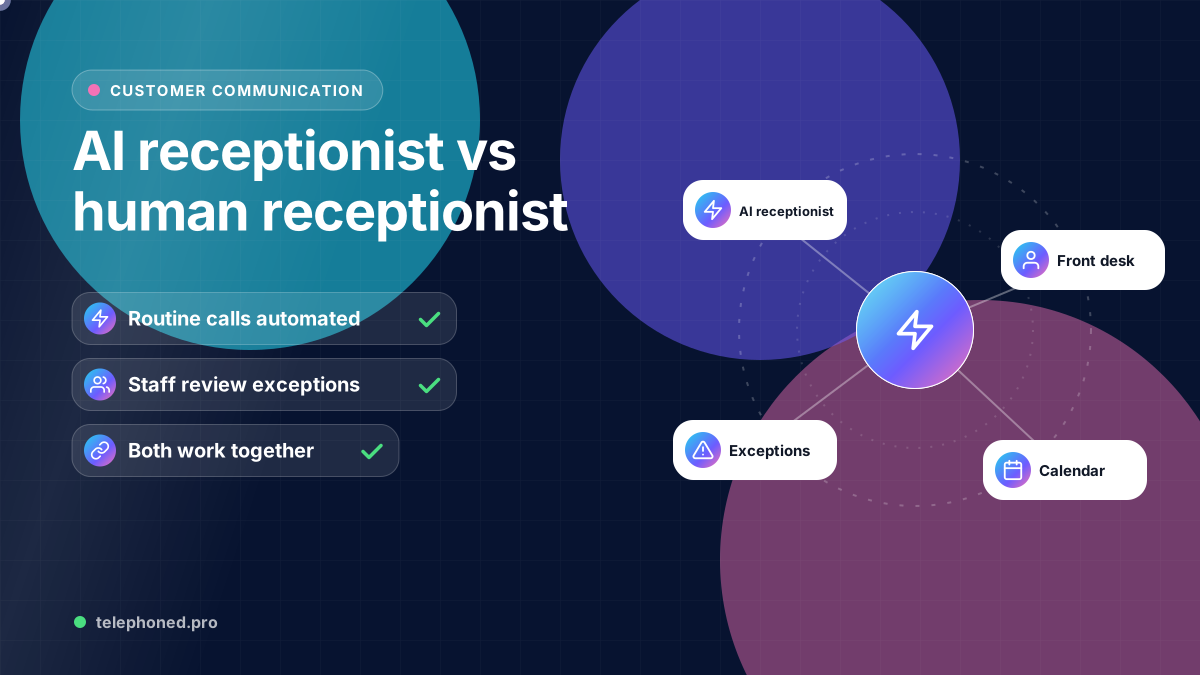
Plan a hybrid front desk: define AI tasks, staff responsibilities, handoff acceptance and fallback rules across call intake, scheduling and customer follow-up.
Read the guide →AI Receptionist
Robocalls eat front-desk time. See how an AI receptionist screens spam, keeps real customers moving, and what rules to set so no genuine lead gets blocked.
For the wider workflow, explore AI Receptionist for Business: 24/7 Answering & Booking. For a related operating question, read AI Receptionist Call Disposition Reporting: What to Track.
AI-assisted editorial guide from Telephoned.pro, a provider of AI receptionist services. Figures come from the FTC, the FCC and YouMail (a call-blocking vendor), cited below. Screening behavior described here is a set of rules a business configures and approves; call examples are illustrative.
An AI receptionist handles spam and robocalls by answering every call the same way, then deciding from what the caller says and does whether it is a real customer. Recorded sales pitches, silent dialers and scam scripts are ended politely and logged, while genuine callers are booked, answered or handed to your team, so nobody on staff has to pick up the junk.
That matters because blocking too aggressively is just as costly as blocking nothing: one real customer mistaken for spam can be a lost job. This guide explains where spam calls come from, how a well-configured AI receptionist screens them, and the rules to set so real leads always get through.
The Do Not Call Registry protects consumers from many telemarketing calls, but business lines get plenty of junk too: listing upsells, fake warranty offers, auto-dialers that hang up when answered, and scams that spoof local numbers. Every one of those lands on the same line your customers use.
| Call type | What it sounds like | How it is usually handled |
|---|---|---|
| Prerecorded robocall | A recorded message, often with “press 1” | Ended after the recording is detected; logged as spam |
| Silent or abandoned dialer | Silence, a click, then a hang-up | Logged; no callback, no alert to staff |
| Live sales pitch | Someone selling listings, SEO or financing | Polite decline, offer of an email address, then ended |
| Spoofed scam | A caller claiming to be a bank, utility or government office | Never confirms account details; ended and flagged |
| Wrong number | A real person who dialed by mistake | Helped briefly, then ended; not counted as a lead |
| Real customer | Describes a need: a repair, appointment or question | Booked, answered or handed to your team with a summary |
Notice the last row. Screening exists to protect that caller's experience, not to win an argument with robocallers. Every rule you add should be tested against real customer calls before it goes live.
STIR/SHAKEN is the caller ID authentication framework the FCC required voice providers to implement in the IP parts of their networks by June 30, 2021. The originating carrier signs the call with an attestation level: A means it knows the customer and that they are allowed to use the number, B means it knows the customer but not the number, and C means it is only passing the call along from elsewhere.
That is why the conversation matters. A carrier sees the number; an AI receptionist hears what the caller actually wants.
Bring one real scenario to your demo. We will review the intended next step, existing systems and human handoffs.
Book a free demo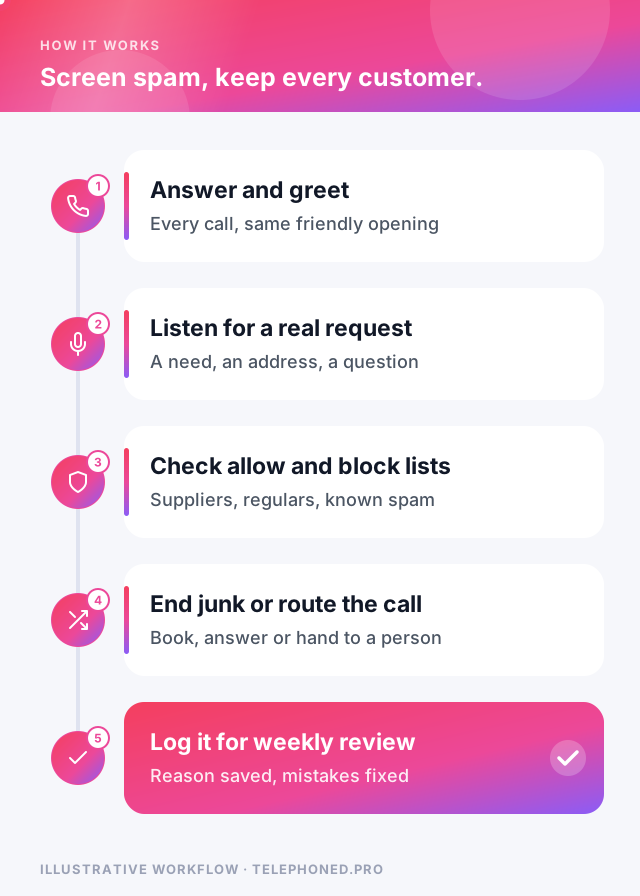
Picture a roofing company in Dallas during hail season. In one afternoon the line gets a homeowner reporting a leak, two recorded “final notice” warranty calls, a silent dialer and a live pitch for Google listing services. A well-set-up AI receptionist answers all five the same way, then sorts them by what happens next.
“The goal isn't to block more calls. It's to make sure your team only spends time on calls from people who need you.”
Review the screened log once a week for the first month. Look for any caller who described a real need and still got ended, then tighten the rule that caught them. The same weekly habit is covered in our guide to call disposition reporting, which shows how to separate spam from lost leads in your numbers.
Done this way, spam stops being a daily interruption and becomes a line in a weekly report, while every real customer still reaches a booking, an answer or a person.
Keep reading
Bring one real workflow. We will show you how calls, follow-up and scheduling could connect for your business.
Keep exploring
The services and decisions that connect to this page.