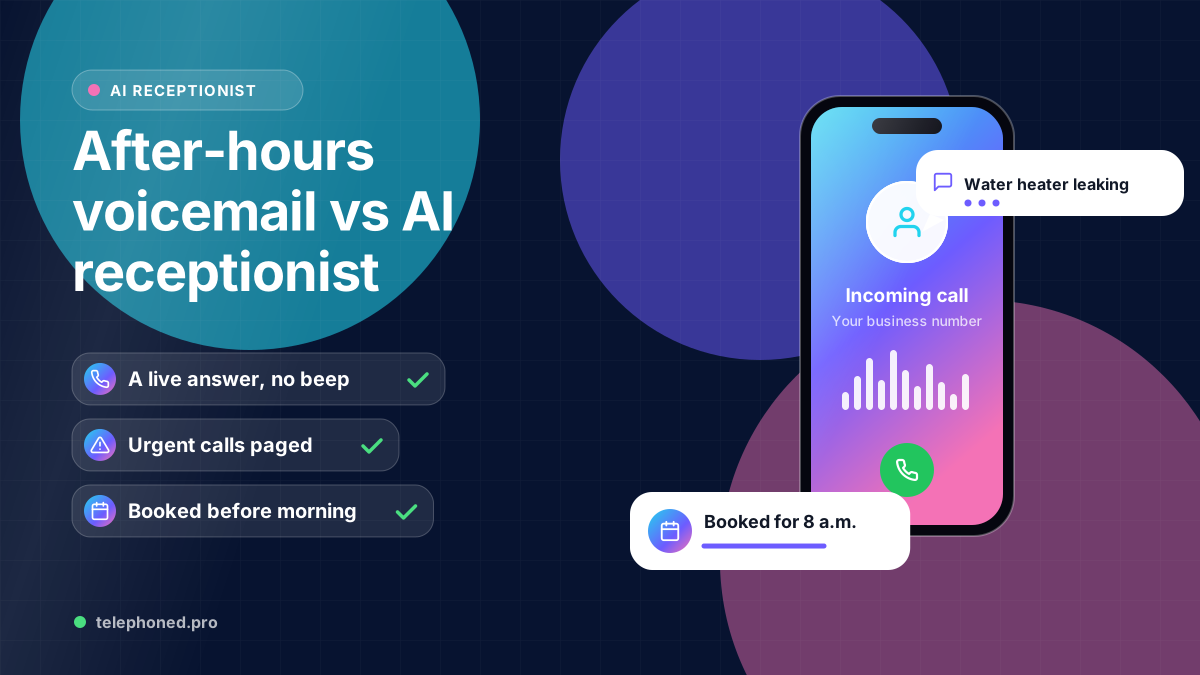
After-Hours Voicemail vs AI Receptionist: What Callers Get
Voicemail or an AI receptionist after hours? See what each caller actually experiences, why callbacks go unanswered, and which calls need a live answer.
Read the guide →AI Receptionist
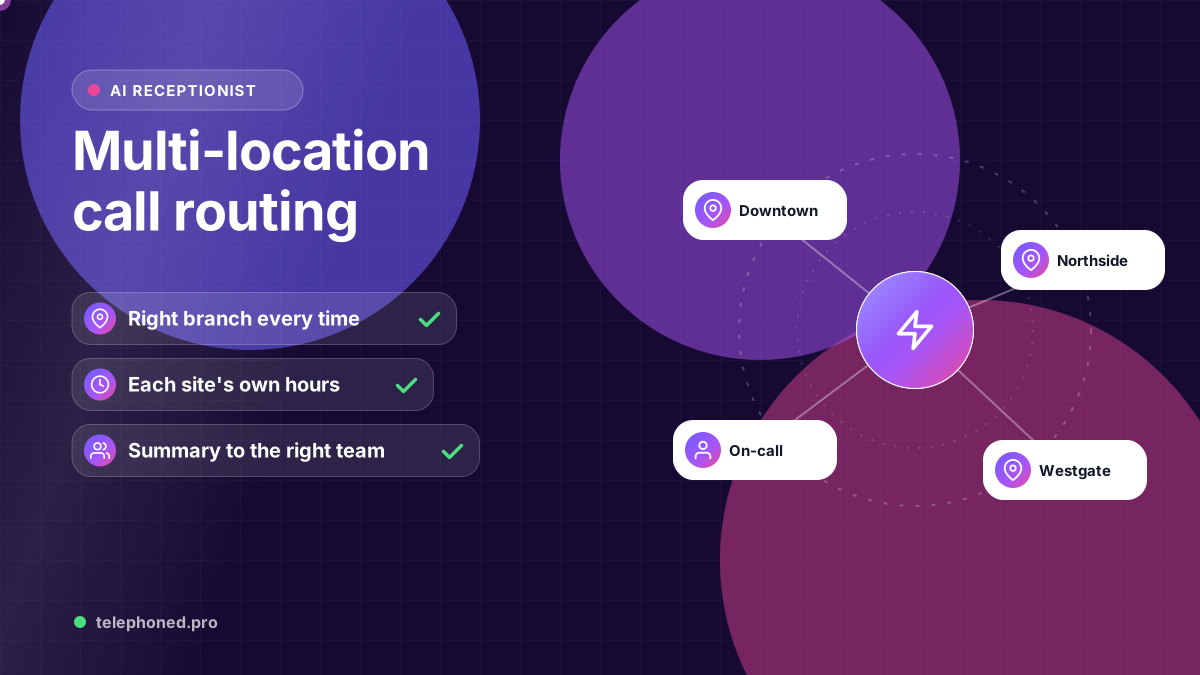
How an AI receptionist routes calls across several locations: by number, ZIP code or caller choice, with each site’s hours, calendar and on-call contact.
For the wider workflow, explore AI Receptionist for Business: 24/7 Answering & Booking. For a related operating question, read AI Receptionist Call Transfer.
AI-assisted editorial guide from Telephoned.pro, a provider of AI receptionist services. Franchise figures come from the International Franchise Association’s 2025 Franchising Economic Outlook (a trade association report prepared by FRANdata), and lead-response figures from a 2011 Harvard Business Review study, both cited below. Scenarios are illustrative, not customer results.
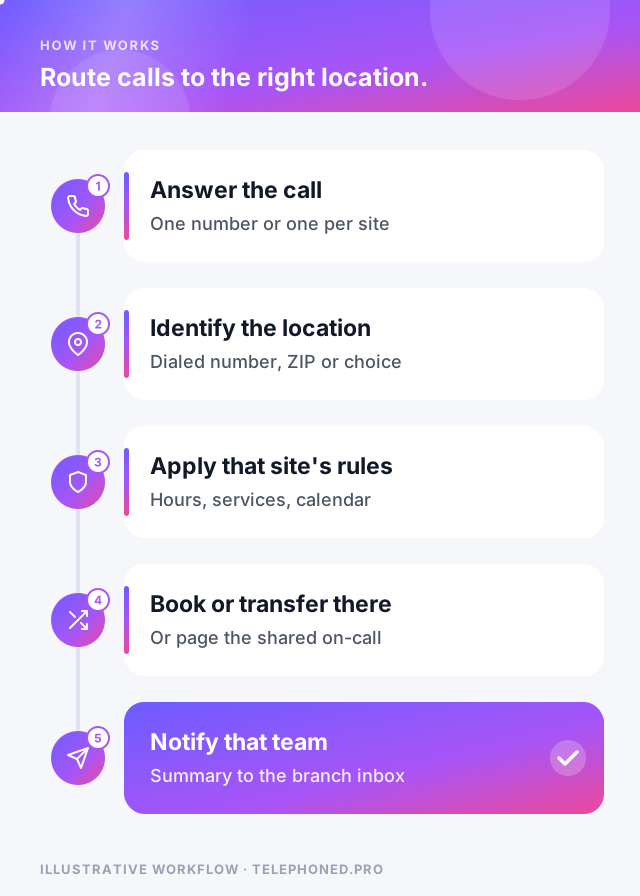
An AI receptionist for a multi-location business works out which location a caller needs, by the number they dialed, the ZIP code they give or the branch they name, and then follows that location’s rules: its hours, its services, its calendar and its on-call contact. Done well, a caller in Tampa never gets booked into the Orlando schedule, and every branch sees only its own calls.
Most routing problems come from treating several locations as one business with one script. This guide covers the three ways to identify the right location, what each location needs to have defined, and how to test it before going live. If calls need to reach a person at a specific branch, our page on AI receptionist call transfer explains how live transfers are set up.
Franchises are only part of the picture: many independent dental groups, HVAC companies and salons run two or more sites too. What they share is a phone problem. Each location has its own staff and schedule, yet callers often find whichever number Google shows first, and a slow or wrong-branch answer costs the booking.
| Method | How it works | Best for | Watch out for |
|---|---|---|---|
| Dialed number | Each location has its own phone number forwarded to the AI | Businesses already listing a number per location | Callers who dial the wrong branch’s number |
| ZIP code or address | The AI asks where the job or customer is and matches it to a service area | Home services that travel to customers | Overlapping service areas need a tie-break rule |
| Caller’s choice | The AI asks which location they want, in plain words | Clinics, salons and shops customers visit | Callers who are unsure, so offer the nearest one |
| Combination | Dialed number first, then confirm with a question | Most multi-location businesses | Keep the confirmation to one short question |
For businesses that travel to customers, ZIP code matching is usually the most reliable, and our service-area qualification workflow shows how to set the rules. For businesses customers visit, the dialed number plus a quick confirmation is usually enough.
“The caller doesn’t care which branch answers. They care that the person who calls back knows their name and their address.”
Bring one real scenario to your demo. We will review the intended next step, existing systems and human handoffs.
Book a free demoKeep these details in one shared sheet with a row per location, and name who updates it. When a manager changes Saturday hours or adds a service, the change goes into the sheet first, then into the AI receptionist’s settings the same day.
Here is an illustrative example. A pediatric dental group has three offices around Charlotte, North Carolina. A parent calls the main number on a Saturday morning and says their child chipped a tooth. The AI asks which office the family usually visits, learns it is the Huntersville office, and sees that Huntersville is closed today but Ballantyne has Saturday hours.
It offers the earliest Ballantyne slot, books it in the Ballantyne calendar, and sends the summary to both offices so the family’s usual team knows what happened. If the parent had described severe pain or swelling after hours, the call would instead have gone to the on-call dentist for the whole group.
If a branch line might go unanswered, set a ring limit and a fallback, as described in our guide to transfers that are not answered. Most businesses keep each location’s existing number and forward it, which our call forwarding guide explains.
Routing is only as good as the rules behind it. If two locations serve the same ZIP code, you need to decide which one wins. Booking into separate calendars depends on a supported connection for each, so confirm that before launch. And when locations change hours, services or staff, the AI’s settings must be updated too, so name one person responsible for keeping them current.
Keep reading
Bring one real workflow. We will show you how calls, follow-up and scheduling could connect for your business.
Keep exploring
The services and decisions that connect to this page.