US business call workflows
AI receptionist for real estate teams
with a clear next action.
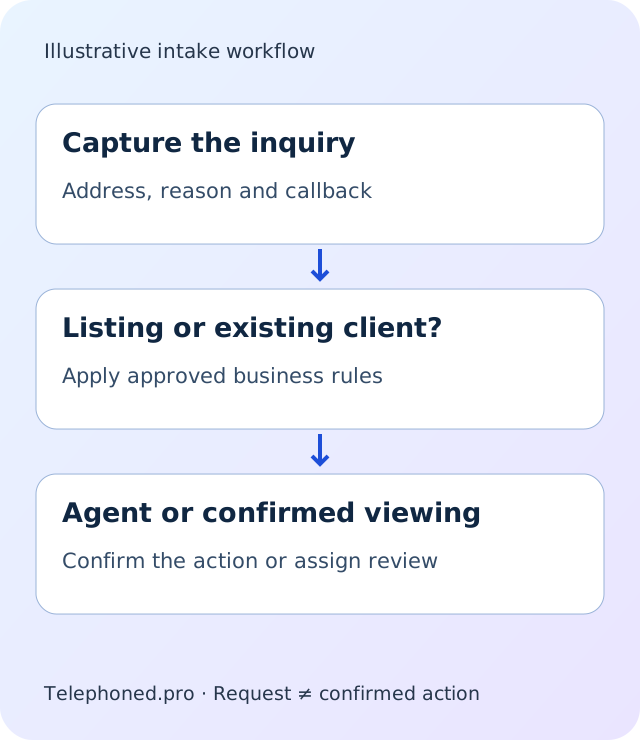
An AI receptionist for real estate teams captures property inquiries, distinguishes buyers, sellers and existing clients, and routes requests to the appropriate agent or approved scheduling workflow. Telephoned.pro scopes that conversation around your listings, assignment rules and current tools. A viewing request remains a request until the necessary availability and access arrangements are confirmed.
Review AI Automation for Real Estate Teams. A related guide to check alongside this page is AI Receptionist for Property Management.
Workflow review
A property inquiry should reach the right agent
Illustrative scenario: a buyer calls about a listing while the assigned agent is in a showing. The caller wants to know whether a viewing is possible that weekend. Useful intake captures the property reference, contact details and preferred next step, then follows the team's approved routing rules. It should not invent listing availability, promise access or imply that a seller has accepted a proposed time.
A seller asking about representation needs a different conversation from a tenant reporting maintenance or a current client asking about a transaction. Identify the purpose before assigning the request. If your team handles only particular inquiry types, keep those boundaries explicit. The assistant should use approved property information and route uncertain questions to an agent rather than supplying a plausible answer.
Workflow review
Design the property inquiry and showing-request flow
Start by identifying the property or the general reason for the call. Confirm the caller's name, callback preference and the details your team needs to continue. Ask only approved questions relevant to the request. Do not turn intake into advice about financing, legal rights or the suitability of a neighborhood. Those subjects need the appropriate professional and the team's own policies.
Apply your assignment rules. A listing-specific inquiry may belong to the listing agent, while a general seller inquiry may follow a rotation or a geographic rule. An active client may already have an owner. Preserve that relationship instead of automatically creating another lead or sending the same inquiry to several agents without a defined responsibility. If the match is uncertain, make the uncertainty visible for review.
For a showing request, check the supported calendar and approved access process. Agent availability alone may not establish property availability. Seller approval, occupancy, showing instructions and other requirements can matter. If any prerequisite remains unresolved, capture the preferred time and explain that confirmation is pending. Once an appointment is actually confirmed, record the relevant details so the agent and caller receive consistent information.
Your call flow
Review a normal request and an exception
Bring your current tools and operating rules. We will distinguish confirmed actions from requests that need your team.
Workflow review
Handle time-sensitive requests without overstepping
A caller may mention an offer deadline, a transaction issue or a problem at an occupied property. Your team decides which requests need immediate escalation and which go into the normal callback queue. The assistant can capture the stated urgency and apply those instructions. It should not interpret contract deadlines, give legal advice or assure a caller that a message protects their position.
Define a fallback for an unavailable agent. A second approved contact, a supervised shared queue or a callback task may be appropriate, depending on your process. The caller needs an accurate explanation of what happened. A ringing transfer is not a completed conversation, and a captured message is not proof the agent has reviewed it. Keep ownership and the next promised action visible.
Review this workflow with your team.
Bring one routine request and one exception. Review existing-number forwarding where supported, plus AI transparency.
Workflow review
What to check before choosing a real estate receptionist
Bring representative inquiry types, assignment rules and the systems that hold property and contact information. Identify which source is authoritative for listing status and who updates it. A stale website description should not override current instructions. Confirm which information can be read safely and which actions require agent approval before connecting any records.
Use the demo to test a listing inquiry, a seller inquiry, an existing client and a caller asking about an unavailable property. Add a caller who changes the property reference mid-conversation. Review the resulting records for the right owner and next action. Check that private access details are not disclosed outside your approved process and that uncertain identities do not cause records to be merged automatically.
Ask about the actual CRM and calendar actions required for your team. A general software connection does not prove that lead assignment, showing approval or follow-up stop rules are supported in your account. Verify those dependencies individually. Use fictional contacts and properties during discovery so you can assess the process without sharing sensitive client documents or credentials.
Workflow review
Connect the call with follow-up your agents can own
After intake, the next action may be a callback, an approved consultation or a showing confirmation. Keep each status distinct. A person who has already spoken with an agent should not continue receiving an unchanged introductory sequence. An opt-out or a change of owner should affect follow-up before another message is sent. Agents need enough context to continue the conversation naturally.
The broader real estate automation guide examines customer records, assignment and operational follow-up. This service page focuses on the phone conversation and the handoff it creates. Start with one clearly defined inquiry type and review normal and exceptional outcomes. The objective is a process that fits your team's existing responsibilities, not a claim that answering more calls automatically produces transactions or replaces professional judgment.
Assign responsibility for keeping listing instructions and agent routing current. Changes to coverage, ownership or access requirements should trigger a review of the relevant call paths before the new instructions are used.
Before you decide
Questions about the proposed setup
Only where your approved calendar and access process can actually confirm it. Otherwise the preferred time should be recorded as a request awaiting confirmation.
It can use approved information supplied for the workflow. Uncertain or time-sensitive listing facts should be routed to the responsible agent.
The proposed routing should preserve the current owner and include a fallback when that agent is unavailable. Review the exact rules in discovery.
Want to hear it on your own calls?
Secure your spotReview the workflow
around your business.
Bring a typical call and one exception. We will explore the right scope, dependencies and staff handoffs before you decide.