Missed Call Follow-Up: An Ownership Guide for US Businesses
Build a missed call follow-up workflow for your US service business: assign one owner, set callback rules and track inquiries through to a booked appointment.
Read the guide →AI Sales Automation
Map AI sales automation from inquiry to qualification, owner assignment, CRM updates and follow-up. Learn when to stop messages and involve your sales team.
For the wider workflow, explore Business Process Automation Services. For a related operating question, read Lead Follow-Up Automation for Sales.
Prepared by the Telephoned.pro team with AI assistance and editorial review. Examples illustrate workflow design; they are not customer results. Integration availability and scope are confirmed during discovery.
AI sales automation connects incoming leads to qualification, owner assignment, CRM updates and timely follow-up. Its purpose is to help the right prospect reach the right sales conversation with accurate context. It should also stop or hand off when the prospect replies, books, declines or needs human judgment.
For a US sales team, the first design decision is where an inquiry enters and who becomes accountable for it. Phone, forms, email and chat can capture different information. Define one record and one current status so parallel channels do not create competing opportunities or conflicting messages.
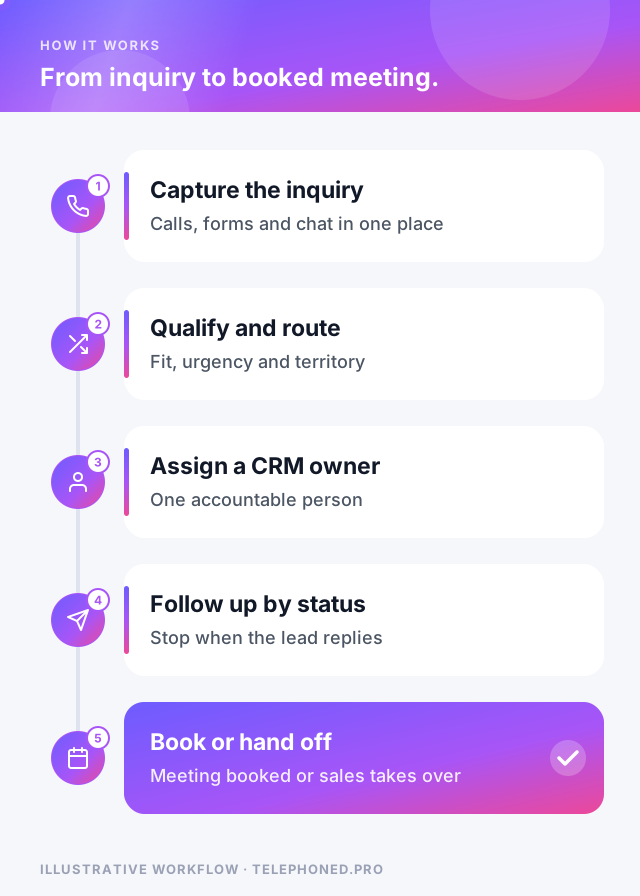
Qualification can gather the requested service, location, timing and other approved fit criteria. AI can help interpret an open-ended description, but the business must define what qualifies and what requires review. A complex enterprise request may need a sales specialist even when its fields are complete. Qualification should prepare the conversation, not claim that a deal has been won.
In an illustrative US company, a prospect requests a consultation through a website form. The workflow checks for an existing account, identifies the relevant location and confirms required details. It creates a CRM task for that location’s sales owner. If the prospect is eligible for direct scheduling, the booking step checks the correct calendar; otherwise the owner receives the inquiry and a clear next action.
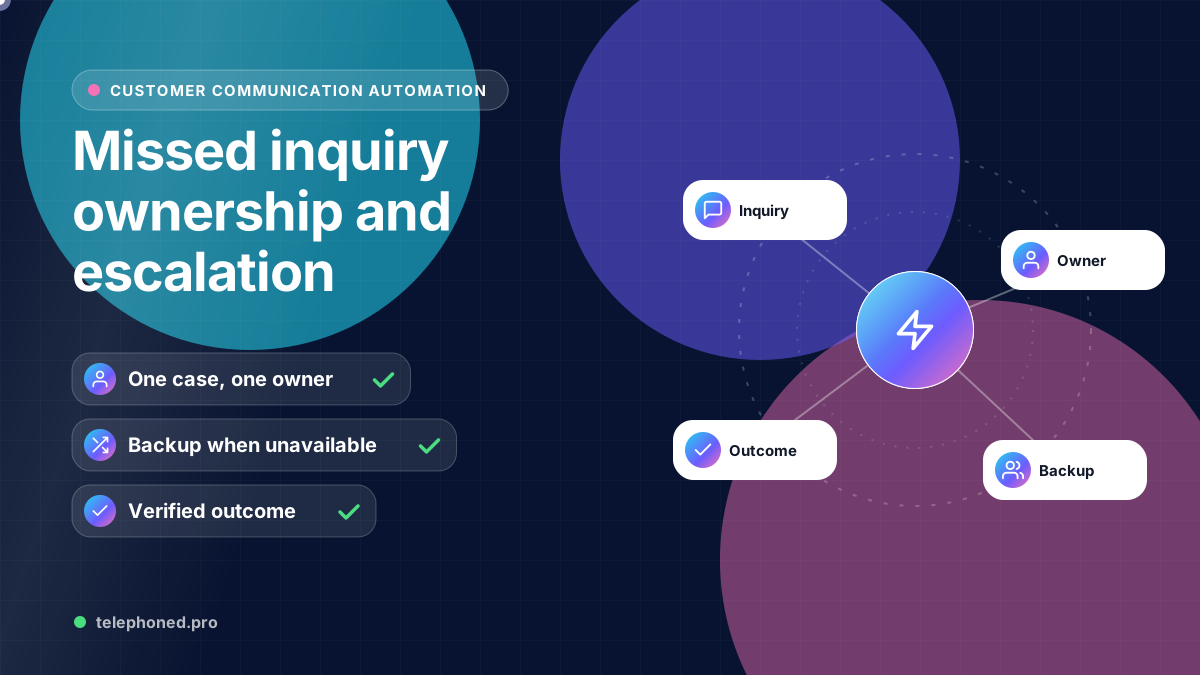
The central team should be able to see which location owns the case. A location change should update the assignment rather than create a competing lead. A missing owner or unavailable integration should enter an exception queue with enough context for staff to recover the handoff.
Before each follow-up, check whether the lead has replied, booked, opted out, been closed or moved to a staff conversation. A sequence based only on elapsed time can send an irrelevant message after the prospect has already taken action. Agree on approved channels, timing, content and contact preferences with the business before launch.
Bring one real scenario to your demo. We will review the intended next step, existing systems and human handoffs.
Secure your spotKeep operational confirmations distinct from sales nurturing. A booking confirmation can explain the next step; a sales message should reflect the prospect’s stage. Where a message needs personal judgment or an unverified answer, create a staff task or draft for review.
Test an existing customer, a duplicate lead, a reply during a sequence, a booking followed by rescheduling and an owner who does not accept the task. Check that every status change reaches the systems that decide the next message. Verify specific CRM and calendar support during discovery; the presence of an API alone does not establish a finished integration.
Measure time to first response, accepted assignments, qualified booked meetings and progression from those meetings. Review completed demos or appointments separately from booking attempts. Compare against your own baseline and retain human review for unclear fit, sensitive requests and important account decisions.
| Sales task | Automate | Keep with your team |
|---|---|---|
| First response | Acknowledge and qualify within minutes, any time of day | Complex or high-value inquiries that need a call |
| Lead routing | Assign by territory, product or account owner | Disputed or shared accounts |
| Meeting booking | Offer the owner's real availability | Exceptions to booking rules |
| Follow-up | Timed reminders that stop on reply or booking | Negotiation and objections |
| CRM updates | Log source, status and next step automatically | Forecast judgments and deal notes |
Speed to first response is where automation usually earns its keep in sales: a prospect who submits a form at 8 p.m. can be acknowledged, qualified and offered a meeting before they contact a competitor, while the salesperson still owns the conversation that follows.
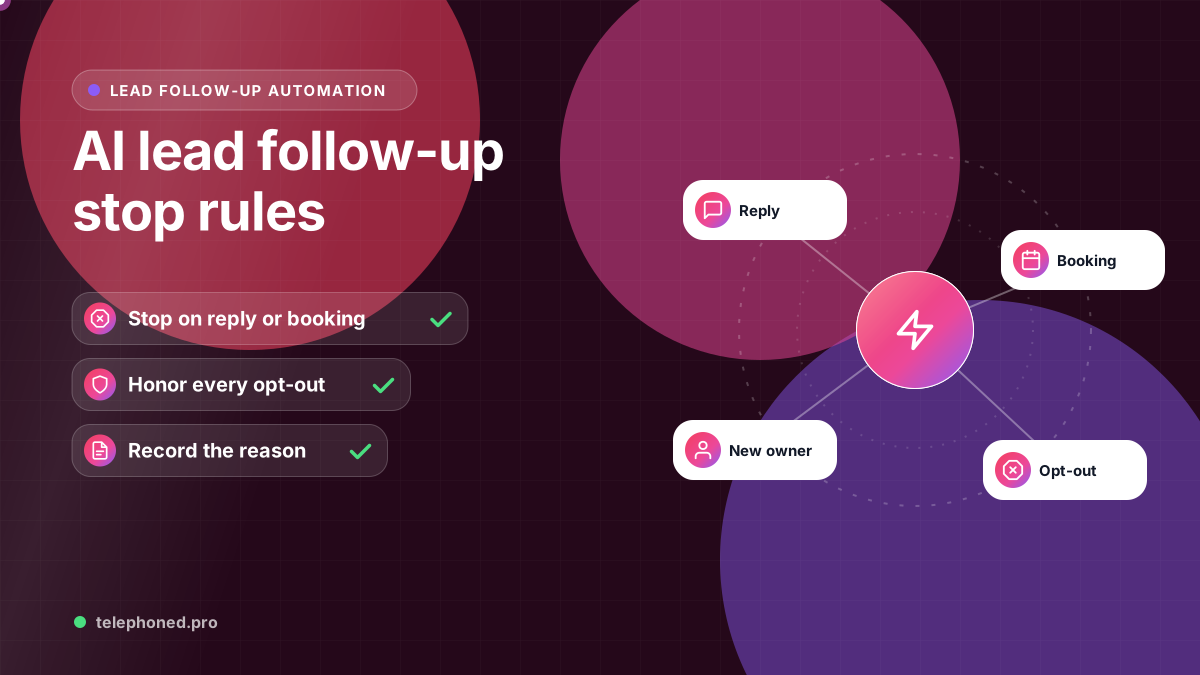
Automated calls and texts in the US are governed by the Telephone Consumer Protection Act. Under the FCC's 2024 consent rules, a person can revoke consent by any reasonable means, including replying STOP to a text, and businesses must honor the request within a short, defined window. Build stop rules into every sequence: a reply, a booking, an opt-out or a change of owner should cancel queued messages immediately. Check specific obligations with your counsel; this guide is not legal advice.
Keep reading
Bring one real workflow. We will show you how calls, follow-up and scheduling could connect for your business.